Construction Site Theft Prevention Through Remote Video Monitoring
Real-time monitoring catches thieves in the act, not after they've vanished.
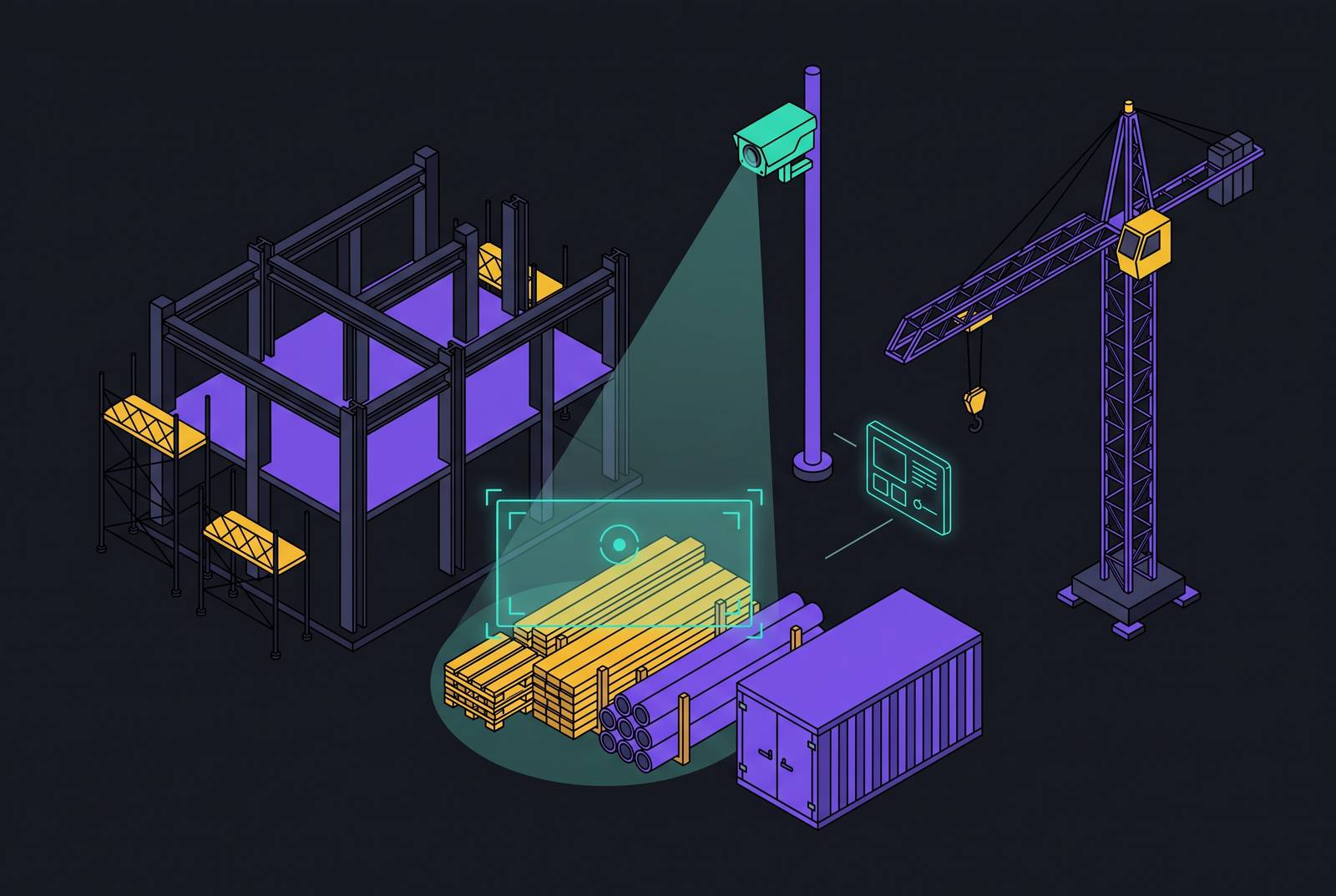
Construction site theft is the predictable outcome of how job sites are designed and operated: high-value equipment, materials, and tools sit unattended for long stretches, often overnight and across weekends, with no active human presence to interrupt anyone who decides to take them. The financial exposure that results is not marginal. Direct annual losses run into the hundreds of millions of dollars, with copper theft alone adding further losses across all industries, and construction sites are a primary target.
What makes a job site so exploitable is the mismatch between asset density and asset supervision. A single laydown yard might hold skid steers, generators, spools of copper wiring, and pallets of lumber worth far more than the fencing meant to protect them, yet that fencing is often the only thing standing between the equipment and an open road. Once equipment or material is removed from a site, tracing it becomes close to impossible. A peer-reviewed analysis of FBI incident data found that less than 7% of single-item stolen construction property, tools and small equipment in particular, is ever recovered. Trucks are the exception, because a registered VIN gives law enforcement something to search for. Unmarked tools and equipment carry no equivalent identifier, so once they leave the site, they are effectively untraceable.
The exposure also follows a schedule. Sites are most vulnerable in the very windows when they are least staffed: evenings, weekends, and the early phases of a project, when materials and equipment have been staged for upcoming work but no crew is present to notice anyone moving through the yard. That predictability makes construction sites attractive targets. The conditions repeat from one project to the next. The criminal calculus stays favorable: high reward, low traceability, and a narrow but reliable window of unsupervised access.
This is also no longer a problem limited to the opportunistic thief cutting a padlock. Organized crews increasingly use reconnaissance and coordinated logistics to identify which sites carry the most valuable, most portable assets, and to plan removal operations that can be executed and gone before anyone arrives. Against that kind of operation, a chain-link fence and a sign warning of surveillance are not a deterrent so much as a formality. The exposure is structural, so the fix has to match that structure: a security layer that can act while the theft is happening rather than one that only documents it afterward.
Why passive security measures fail
The standard security stack on a construction site, fencing, signage, padlocks, an on-site guard, and cameras that simply record, addresses presence but not activity. It draws a boundary a determined thief can still cross, and it produces footage that proves a loss occurred rather than stopping the loss from happening.
Guard coverage is the most expensive piece of that stack and among the least scalable. Shift changes, fatigue, and simple human distraction erode even that limited coverage over the course of a night, and none of it scales to a multi-acre site with dozens of separate vulnerable zones, gates, trailers, fuel tanks, and equipment parks that a single guard cannot watch simultaneously.
Cameras that only record carry the same structural flaw in a different form. Footage that nobody is watching in real time has no way to interrupt a theft while it is underway. Published meta-analysis research in Criminology & Public Policy found that camera schemes incorporating active monitoring produced larger reductions in crime than passive, recording-only systems. The camera only changes the outcome if someone is watching it in time to act on what it shows.
GPS tracking on equipment addresses a different problem entirely, recovery rather than prevention, and even there its value is limited.
What unites every item on this list is that each one reacts after a loss has already occurred. A theft that takes minutes to execute cannot be stopped by a security posture built around hours-later review, delayed patrols, or after-the-fact tracking. The gap between how fast a theft happens and how slowly a passive system responds is exactly the gap that active, real-time monitoring is built to close.
How remote video monitoring works on a construction site
Active remote video monitoring is a continuous review process built around detection technology paired with trained human operators who can intervene while a threat is still developing on-site.
The sequence begins with detection: a motion event, a perimeter breach, or a behavioral anomaly triggers a review. A trained operator then examines live and contextual footage to judge whether the activity is a genuine threat or something authorized, a subcontractor arriving early, a delivery truck backing into a gate, weather moving through the site. Once a threat is verified, the system escalates through a graduated response. That might start with an audio challenge warning that the site is monitored and instructing the individual to leave, move to sirens and floodlights if the activity continues, and end with direct dispatch to law enforcement if the threat persists.
This same infrastructure fills a gap that guard patrols cannot economically cover: the long stretches of overnight and weekend time when no one is physically present. Operators conduct virtual guard tours, inspecting site cameras at scheduled intervals and checking gates, trailers, laydown yards, fuel areas, equipment zones, and fence lines, essentially replicating a foot patrol without the cost of staffing one, and without the single-point vulnerability of a guard who can only be in one place.
Speed is the variable that makes this architecture work. Remote monitoring achieves a response time of 10 to 20 seconds from detection to operator review, compared to a much longer wait for an on-site guard patrol to physically reach a given zone. That gap matters because a coordinated theft of heavy equipment can be loaded and gone within minutes.
Coverage extends even to sites without permanent power. Mobile surveillance trailers, solar-powered, self-contained units equipped with cameras, lighting, and two-way audio, bring monitored coverage to a site before permanent infrastructure exists, which describes most active construction phases. And the presence of that infrastructure does real work even when no incident occurs. Visible cameras, lighting, and audio capability discourage both opportunistic thieves and organized crews that scout sites in advance, because a site that is obviously watched is a worse target than one that is not.
What AI agents contribute to the monitoring process on a job site
AI agents in a monitoring stack are not a replacement for the human operator. Their job is to handle the high-volume pattern-recognition work so that operators see only the events that genuinely need a decision.
The meaningful advance over earlier motion-detection analytics is temporal reasoning. Earlier systems asked a narrow question: did motion occur? Current AI architectures instead evaluate behavioral sequences over time, whether a person moving toward a laydown yard at 2 a.m. matches a pattern consistent with prior intrusions, for instance, rather than flagging every shape that crosses a sensor. That shift from a single frame to a sequence of behavior is what separates an alert worth an operator's attention from background noise.
Construction sites generate an unusually high volume of environmental triggers, rain, shifting shadows, headlights sweeping across a yard, wind moving a flag, vehicles passing on an adjacent road. Simple motion-based systems get overwhelmed by exactly this kind of noise. AI filtering removes it before it ever reaches a human reviewer.
That division of labor is the point. The AI layer scans feeds continuously, filters out environmental noise, flags behavioral anomalies, and assembles the surrounding clip context so an operator does not have to scrub through footage cold. The human operator verifies what the system flags, interprets ambiguous cases, decides how to respond, and carries out the response, issuing a voice challenge, triggering sirens or lighting, or making the call to dispatch law enforcement.
AI cannot be handed that last step. Judgment calls about ambiguous activity, the accountability of speaking directly to someone on-site, and the coordination required to bring in law enforcement all depend on a human decision-maker who can adapt to a situation the training data never anticipated. What AI changes is the volume a human operator can responsibly handle. By clearing out noise and surfacing only the anomalies that matter, this architecture lets a limited number of trained operators cover many sites at once instead of a handful, which is what makes the entire model financially viable at scale.
Why the queue problem makes traditional monitoring centers unreliable
A monitoring center that lacks AI filtering cannot deliver fast, accurate responses once alarm volume rises, no matter how many operators it staffs. The bottleneck is the ratio of real threats to false alarms flowing into the queue, not a shortage of people.
Industry research consistently finds that 90 to 99% of alarms received by traditional monitoring centers turn out to be false or non-actionable, and construction sites make that ratio worse, because open-air, unfinished environments generate environmental triggers that indoor commercial sites rarely produce. Every one of those false alarms still has to be opened, reviewed, and dismissed by a human being before the next one in line gets a look.
That queue degrades in a way that compounds over a shift rather than staying constant. Operators under sustained alarm load start triaging by instinct instead of by careful review, and situational awareness erodes with fatigue faster than most monitoring center schedules account for. Reliability drops precisely when it matters most: later in a shift, during a high-volume overnight stretch, or on a weekend when call volume across an entire monitoring center spikes at once.
The downstream consequence on a job site is specific and costly. A crew cutting a perimeter fence at 2 a.m. generates one alarm among dozens of false triggers moving through the same queue. By the time an operator reaches that alarm in sequence, the equipment is already loaded and moving off the property.
This is why the meaningful performance figure for a construction site is not "time to first alert" but time from trigger to a verified, dispatch-quality event. Law enforcement prioritizes alarms that come with video verification over raw, unverified motion alerts, and that prioritization decides whether police arrive while the theft is still in progress or after it is already over. A monitoring provider's service commitment should break that figure into separate, auditable components: detection latency, time to operator review, verification accuracy, and dispatch-to-law-enforcement time, rather than folding them into a single marketing number.
How site-specific protocols separate threats from authorized activity
Detection technology and trained operators solve part of the problem. Without site-specific knowledge, even a well-built monitoring system cannot reliably tell a theft in progress from a subcontractor showing up before dawn, and that failure runs in both directions: it produces excessive false dispatches, or worse, lets a genuine threat pass because it resembles routine site activity.
Construction sites do not operate on a fixed schedule the way a retail storefront does. Early-morning deliveries, after-hours equipment moves, weekend concrete pours, and rotating crews from different subcontractors are all legitimate events that, to a generic ruleset, look identical to an intrusion. A system with no knowledge of what is supposed to happen at a given gate at a given hour has no way to separate the two.
Closing that gap takes real, ongoing configuration work. It means defining authorized-hours windows separately for each zone, the main gate, the laydown yard, the trailer area, the equipment park. It means maintaining current rosters of approved personnel and vehicles, so an operator reviewing footage has something concrete to check activity against. It means encoding escalation contacts by shift and by incident type, so the right person gets called for a fence breach and a different person gets called for a fuel-area alarm, since a fuel tank area warrants a different response than a perimeter gate does.
Skipping that configuration turns AI detection from an improvement into a liability. It becomes a faster way to generate false dispatches, adding to the queue backlog instead of clearing it. Virtual guard tours depend on this same groundwork. An operator checking cameras against a known site layout at scheduled intervals can spot what looks wrong precisely because that operator knows what the site is supposed to look like at that hour, on that day, in that season of the project.
This configuration layer is also what a construction site owner is actually paying for. A provider that skips it is selling generic alarm coverage with a monitoring label attached. A provider that does the work is selling a system that understands the site it protects, which is the only version of remote monitoring that holds up once the economics are examined closely.
The economics of remote monitoring versus the cost of theft
Guard coverage sets the baseline for comparison, and it is not cheap. Remote video monitoring typically costs a fraction of that per site, for coverage that matches or exceeds guard presence and adds live intervention capability that a single guard walking a perimeter cannot provide.
Set beside the cost of what goes unprevented, the comparison gets starker. A site that loses a piece of heavy equipment to an organized theft is not just out the replacement cost of that machine. Project delays push deadlines back. Rental equipment has to be brought in while a replacement is sourced, often at a premium, since the need is unplanned. Crews sit idle waiting on the equipment that would let them keep working. Insurance premiums climb after a claim. Someone has to handle the police report and the claims paperwork on top of everything else already on a project manager's plate. None of that appears in a simple asset-replacement calculation, yet all of it is real cost that compounds the moment equipment goes missing.
Set against that full cost picture, monitoring does not need to prevent many incidents to pay for itself many times over. A single averted theft of heavy equipment can cover the cost of a monitoring deployment for the length of an entire project, several times over in some cases, which turns the investment decision from a close call into an obvious one once the comparison is made honestly.
None of that economic case holds, though, if the monitoring itself is generic. A system that has not been configured to a site's authorized-hours windows, personnel rosters, and zone-specific protocols will generate the false-dispatch pattern described earlier, degrading both its own effectiveness and its standing with local law enforcement. The economics only work when the architecture and the configuration behind them are sound, which is precisely what a site owner needs to verify before signing a contract.
What to verify before selecting a remote monitoring provider
Buying remote video monitoring without examining a provider's architecture and configuration depth is how a site owner ends up paying active-monitoring prices for what amounts to passive recording with a monitoring label attached.
Ask directly whether the provider filters alarms through an AI layer before a human ever sees them, or whether every camera trigger lands straight in a human triage queue. That answer shows whether a stated response-time commitment reflects how the system actually performs or simply describes an ideal case.
Demand a service-level agreement broken into separate, auditable components rather than one marketing number. Detection latency, time from trigger to operator review, verification accuracy rate, and dispatch-to-law-enforcement time should each be stated on their own, because a single blended "response time" figure can hide a slow step behind a fast one.
Examine how deeply the provider configures the system to the site itself. Will authorized-hours windows, personnel and vehicle rosters, zone-specific response protocols, and shift-based escalation contacts actually be built into the deployment, or will the site run on a generic ruleset shared across every customer? A generic ruleset is what produces the false-dispatch rate that erodes a system's standing with dispatch services over time.
Confirm, too, that local law enforcement in the site's jurisdiction treats verified, video-confirmed alarms as priority-response events, and that the provider's verification standard actually meets that threshold. Dispatch services managing high call volumes increasingly deprioritize alarms that arrive without video confirmation, so a provider's verification quality determines, in practice, whether a call for help gets a fast answer or waits in line behind everything else competing for a dispatcher's attention.
The site owner who checks each of these points before signing a contract is not being cautious for its own sake. They are matching the security layer to the exposure described at the outset: a threat that moves in minutes, on a schedule that repeats project after project, against assets that vanish the moment they leave the fence line. Only a monitoring system built on verified architecture, auditable response times, and site-specific configuration is positioned to meet that threat on its own terms.