Alarm Queue Math in Central Monitoring Stations
Most alarms are false, yet real threats still wait behind them in sequential queues.
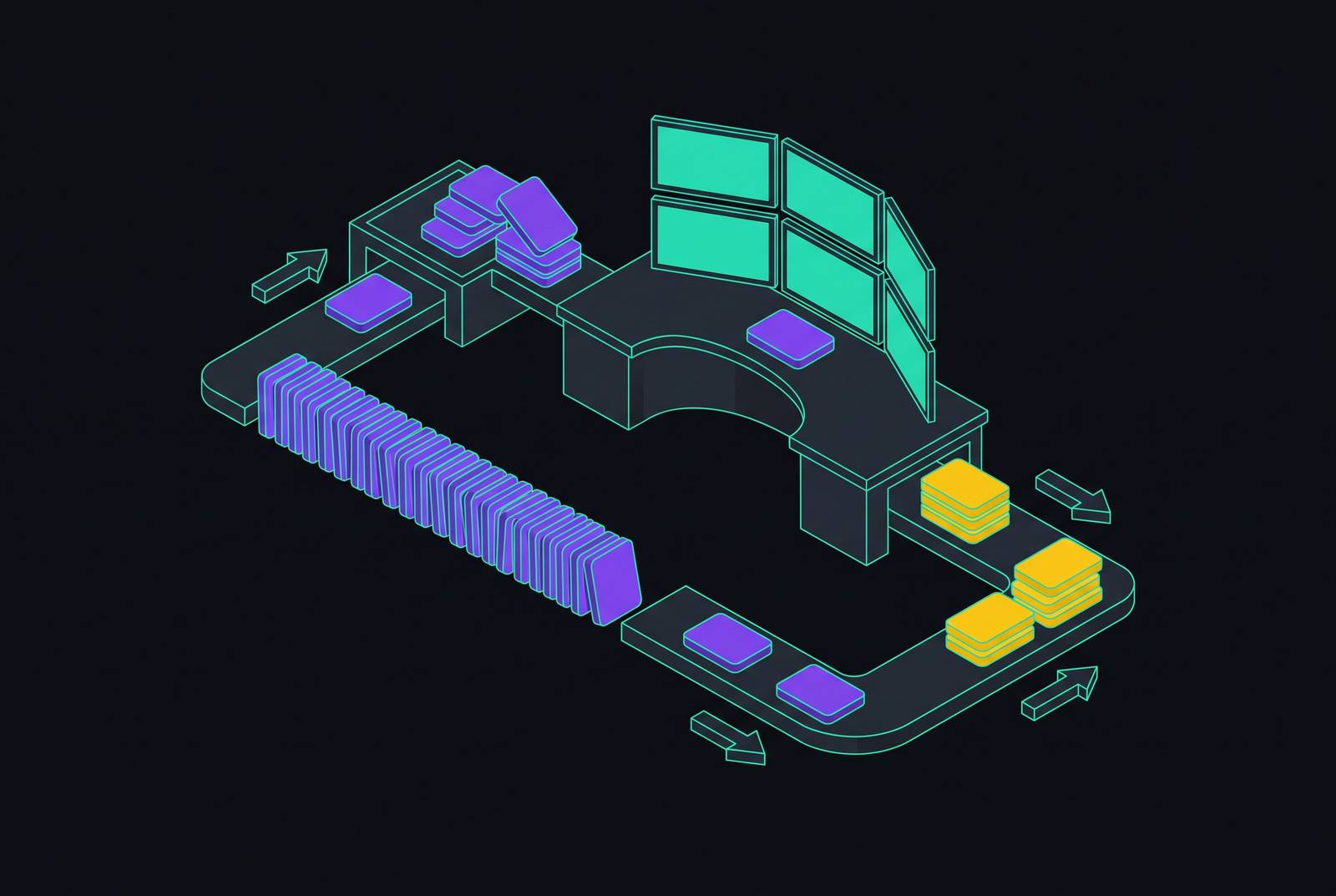
A central monitoring station runs on a queue, and every alarm signal has to pass through a fixed sequence, in order. A signal arrives at the station, gets placed into the queue, and waits there until an operator is free. Only once that operator is available does the system pull the signal forward and match it against the account's customer data, at which point the operator reviews the event and follows the response procedure the software has built into that account's profile. Nothing about this sequence allows a signal to skip ahead: the alarm that arrived first is handled first, and the alarm that arrived fifth waits behind the four that preceded it, regardless of what either alarm actually represents. The operator is the single gate through which every signal must pass before any action, human or otherwise, gets taken, and the scripted action plans tied to each account exist precisely so that once a human does reach a signal, the correct next step is already determined rather than improvised. This design was built for a world in which alarm volume stayed within what a staffed floor of operators could reasonably absorb, and in that world, a strictly sequential, human-gated pipeline was a sound way to guarantee that every signal got looked at by someone trained to judge it.
The queue's breaking point
The queue described above was built on an assumption that no longer holds: that most of what arrives in it deserves the attention it demands. In practice, nineteen out of every twenty alarm signals that enter a central monitoring station turn out to be false, so the queue operators drain each shift is made up almost entirely of events that need no action at all. Each one of those false alarms still occupies a slot in the queue, still requires an operator to pull it, assess it, and dismiss it, and still takes time to clear, roughly 15 seconds per event. The queue is a waiting room where noise and genuine threats sit in the same line, indistinguishable from one another until an operator actually looks at each one in turn, not a filter that screens out noise before a human has to deal with it.
This is the arithmetic that breaks the system, and it is worth being precise about why. Adding operators increases the rate at which the queue gets drained, but it does nothing to change the ratio of noise to signal sitting inside it. The problem compounds further once alarm fatigue enters the picture: operators who have spent a shift dismissing hundreds of false alarms in a row approach each new signal with less acuity than the one before it, high false alarm rates measurably impair precision and slow task completion as desensitization sets in. The architecture creates a queue that is mostly noise, and that noise then degrades the judgment of the very operators the queue depends on to find what matters inside it.
A real threat's wait in the queue
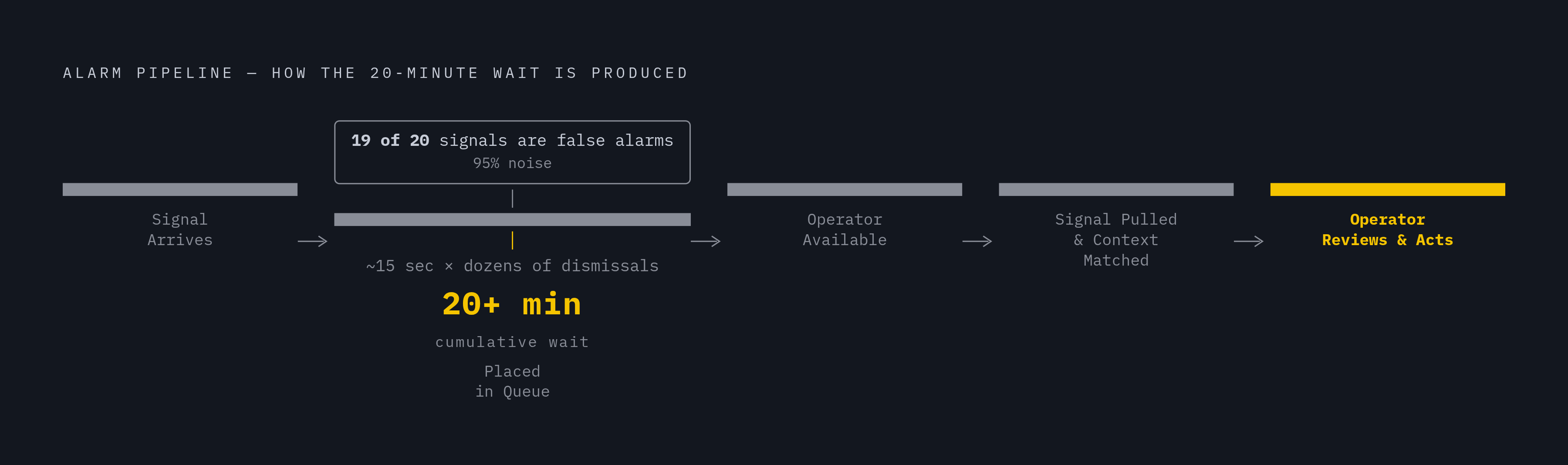
A verified threat entering this queue does not receive special treatment. It waits behind every false alarm that arrived before it, because the system has no mechanism for telling a real threat apart from noise until an operator's eyes land on it, and the queue processes strictly in the order signals arrive, so at roughly 15 seconds per dismissal, a stack of several dozen false alarms ahead of a real threat produces wait times that stretch into many minutes before a human being ever reviews the event that actually mattered, with some legacy monitoring scenarios pushing past twenty minutes before a genuine threat reaches an operator.
The delay does not stop once the alarm clears the CMS queue. Over 98% of police dispatches generated by traditional alarm monitoring turn out to be false, and law enforcement agencies have adjusted their own priorities accordingly, assigning unverified alarm events a non-critical or lower-priority status as a matter of course. A real threat that finally clears the monitoring queue and reaches dispatch arrives into a system already predisposed to treat it as probably false, because the overwhelming majority of what dispatch has received historically has been exactly that. You cannot legislate verification into the dispatch layer on a wide enough scale for it to matter. It has to happen earlier, inside the monitoring station itself, before a signal ever reaches a queue built on the assumption that a human must look at everything before anything gets decided.
Surge volume and the queue's hard ceiling on throughput
A sequential, operator-gated queue has a throughput ceiling set by exactly one variable: how many operators are on the floor at a given moment. Under ordinary volume, that ceiling rarely becomes visible, because the number of incoming signals stays within what the floor can absorb. Surge conditions change that instantly. Shift changes, weather events, after-hours periods, and any event that triggers simultaneous alerts across many accounts at once can push incoming volume past what available operators can drain in real time, and once that happens, the queue does not slow down gracefully, it stacks. Every new alarm that arrives while operators are occupied adds its own wait time on top of the wait time already accumulated by everything ahead of it in line, and a real threat unlucky enough to arrive during one of these surges inherits the full depth of whatever backlog has built up before it.
The legacy answer to surge has been to staff more operators, and that answer does not scale on the timeline surge actually demands. Operators cannot be summoned the moment volume spikes; surge staffing requires scheduling or on-call pools arranged well in advance, both of which lag behind the event they are meant to cover. The industry itself has started to acknowledge that human-only scaling runs into a hard ceiling. Guardian Alarm has pointed to the ability of AI to scale parts of its business, such as its Virtual Guardian remote video monitoring offering, by identifying and triggering on the right events rather than the false ones, a framing that amounts to an admission that adding headcount alone cannot push past the limits built into the legacy model.
Fixing the queue rather than staffing around it
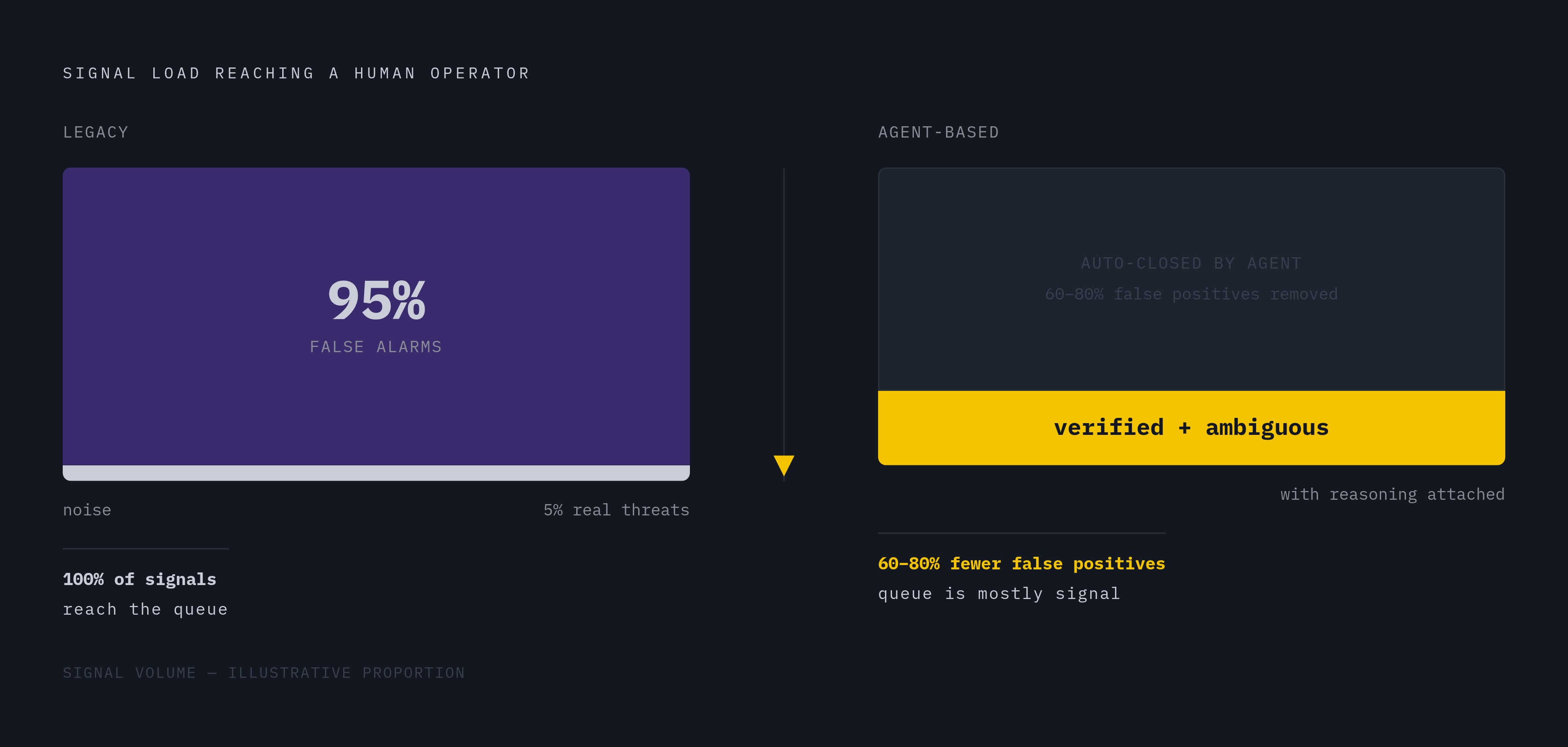
The queue's failure is not that too few operators are working it. The failure is that every alarm, regardless of its merit, must be touched by a human before anything downstream can happen, and that requirement is what sets the ceiling discussed above. Removing the first-pass review from the human layer entirely is the only fix capable of changing that ceiling. It means replacing filtering with reasoning. Legacy architecture filters: it flags a signal based on a threshold breach and passes it to an operator regardless of context. An agent-based architecture reasons: it evaluates the context surrounding an alert, applies the rules specific to that site, and decides whether a human needs to see the event. An AI agent that can ingest an alert, enrich it with context, apply behavioral analysis, and then either auto-close a benign event or escalate a verified threat removes false alarms from the human queue before they ever occupy a slot in it.
The scale of that removal is not marginal. Single-agent triage applied to security operations has been shown to cut false positives by 60 to 80%, and that holds whether you apply it to a cyber alert stream or a physical alarm stream. That does not mean the operator disappears from the process. The agent determines which alarms actually warrant a human's attention, so that attention gets applied only where it is genuinely needed. For that arrangement to hold up under scrutiny, the agent's reasoning has to be visible alongside its conclusion. An agent that announces a false positive with no explanation forces the operator into one of two bad positions, either trusting the call blindly or reinvestigating the event from scratch, and either outcome erases the throughput gain the agent was supposed to deliver. An agent built to show its reasoning, pulling context from relevant sources, testing hypotheses against that context, and attributing its conclusion to specific evidence, gives the operator something to validate rather than something to take on faith. Once that validation step is fast because the agent has already cleared the noise and surfaced what matters, the human review that remains is both quicker and more accurate than anything the original queue could produce.
How site-specific context shapes an AI agent's decisions
An agent's capacity to tell a real threat apart from authorized activity rests entirely on whether it has been given the site-specific context that makes that distinction possible in the first place. An employee walking into a building at 2 a.m. looks, to a context-free system, exactly like an intruder walking into the same building at the same hour, and the only thing that separates the two cases is whether the system has been told what authorized activity looks like at that site, at that hour, on that day of the week. Configuring that context, entry windows for authorized personnel, expected vehicle types, known individuals, rules specific to a given zone of a property, is what turns a generic detection capability into a decision that actually means something. The granularity a provider builds into that configuration, how specifically it can define the objects and behaviors a given client actually wants flagged, is what determines how many unnecessary alarms ever reach an operator's desk, and that granularity is an achievement of configuration work, not a feature of the underlying model alone.
Operators managing multiple sites face a version of this problem that cuts in two directions at once. Industry frameworks have already begun building this kind of specificity directly into the infrastructure that sits between monitoring and dispatch. The AVS-01 Scoring Framework scores each alarm event against the evidence available before a dispatch decision gets made, and site-specific configuration is the mechanism that determines how that score translates into dispatch priority. ASAP, the Automated Secure Alarm Protocol, transmits alarm events directly into participating public safety agencies' CAD systems, so it compresses the last-mile delay between a verified event and an emergency response. Neither framework exists as a matter of preference. Both exist because the industry has recognized that protocol specificity is a mechanism for improving actual response outcomes, and an agent without access to that same specificity is just a faster version of the threshold-based filtering that failed inside the legacy queue to begin with.
The queue problem across commercial, multifamily, and industrial sites
The underlying queue math stays constant across every sector a monitoring provider serves, but what the agent needs to know to separate threat from noise changes a lot depending on what kind of site is generating the signal.
Commercial sites operating across multiple locations, retail chains and office portfolios in particular, face the challenge of pulling intrusion detection, access control, and video into one coherent alarm stream spanning many properties at once.
Multifamily residential properties face a sharper version of the same problem. Access control integration matters here because the monitoring layer has to carry current, up-to-date access permissions if it is going to make any decision that actually means something.
Industrial and warehousing sites introduce a different kind of noise problem. Virtual tripwires, queue monitoring, and occupancy tracking push discrimination down into the detection layer itself, so site-specific logic gets encoded there instead of left for an operator to sort out alarm by alarm.
Response-time architecture determines whether monitoring agreements mean anything
A service-level agreement in this industry typically promises a response time, some number of seconds or minutes within which a signal will be reviewed once it reaches an available operator. That promise describes only one segment of the path a real threat actually travels. It says nothing about how long the signal waited in the queue before an operator became available to review it in the first place, and the preceding sections have shown that wait can run into many minutes once false alarms, surge volume, and shift-change timing are accounted for.
That makes the architecture behind a response-time guarantee more consequential than the guarantee's stated number. If a station has removed false alarms from the queue before they ever reach an operator, through agent-based triage configured with genuine site-specific context, its response-time commitment is measured against a queue that is mostly real signal. A station that has not changed its underlying architecture is offering the identical commitment measured against a queue that is still 95% noise, and the number on paper can look the same in both cases while describing two entirely different experiences for whatever genuine threat happens to be sitting in that queue.