Offshore Monitoring Center Tradeoffs for Commercial Security
Offshoring cuts labor costs but leaves the real problem—response delays—untouched.
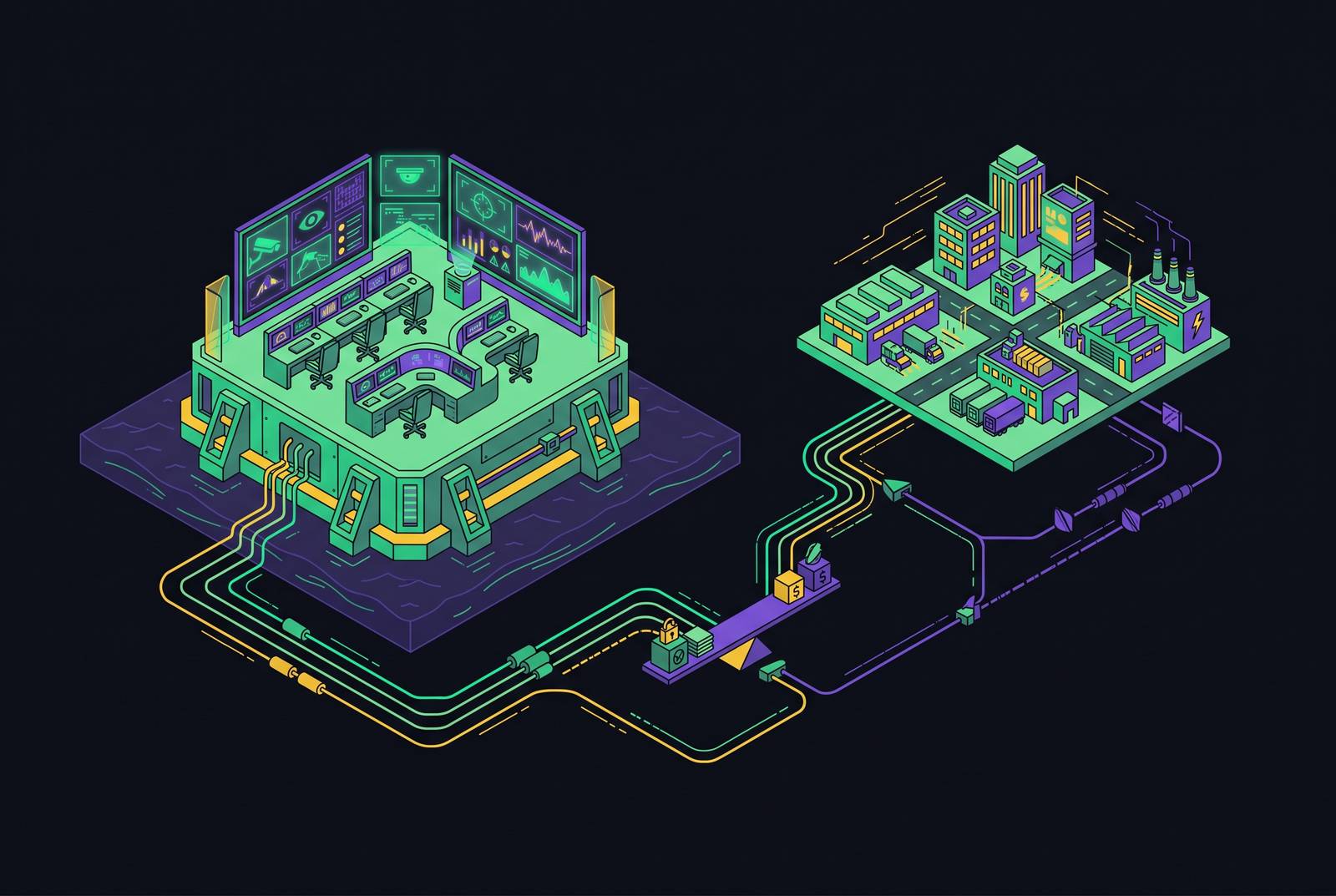
A commercial monitoring program lives or dies on one number: how long a real threat waits behind everything else in the queue before a human looks at it. Offshoring a monitoring center changes what a company pays per hour of labor. It does nothing to change that wait, because the wait is a function of alarm volume and human attention, not of where the operator sits or how much they are paid.
Why the queue problem is structural
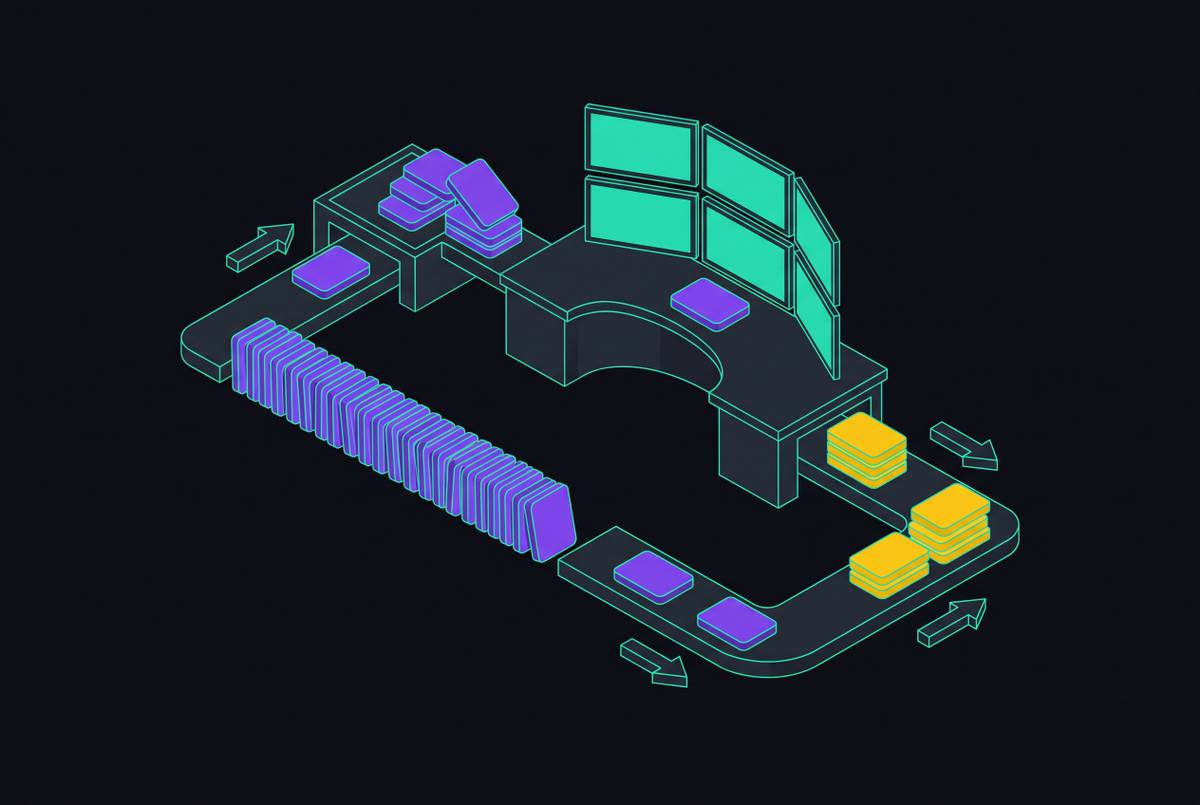
Picture an operator at the start of a shift, watching a wall of camera feeds from a dozen commercial sites at once. Most of what crosses that screen in the next eight hours will be nothing: a delivery truck, a raccoon, a branch moving in wind, an employee badging in early. Genuine threats make up a small sliver of the total alarm count on any given day. Even a sharp, attentive, well-trained operator will spend the overwhelming majority of their shift sorting through events that turn out to be nothing. A real event, when it finally arrives, does not get to skip the line. It waits behind whatever arrived first.
This is not a story about weak hiring or poor training. A peer-reviewed review of alarm fatigue in hospital telemetry monitoring found that alarm fatigue comes from a tangle of systemic conditions, technology design and human limits acting together, not from any one clinician failing at their job, and that high alarm volume wearing down attention over time is a documented contributor to serious downstream harm. The same mechanics apply to a video monitoring floor. Volume wears down judgment regardless of who is sitting in the chair.
The queue breaks down further under ordinary operating conditions. A documented failure category in monitoring operations involves a station sitting unattended during a break or while the same operator is tied up with a separate emergency, with no backup assigned to cover the gap. And the sheer number of feeds a single operator is asked to watch at once works against them before anything even goes wrong: spreading attention across dozens of simultaneous video streams degrades how well a person can notice and respond to any one of them, and that degradation gets worse, not better, as the number of sites and cameras assigned to a single person grows. The queue problem is baked into the ratio of alarms to attention. No amount of individual skill changes that ratio.
What offshoring changes and leaves untouched
Offshoring a monitoring center lowers the hourly cost of each operator seat, and it can shift coverage into different time zones. Those are the only two things it changes. It does not change how many alarms queue up during a shift, how many of those alarms turn out to be false positives rather than genuine threats, how much a human being can take in and judge at once, or how long a real threat sits waiting while routine alarms clear ahead of it in line.
Run the comparison directly: a monitoring center staffed with lower-cost operators, processing the identical alarm volume at the identical queue depth as a domestic one, will surface a verified threat on roughly the same delayed timeline as before. The delay lives in how the queue is built. In some cases offshoring adds friction rather than removing it: language gaps and unfamiliar communication protocols between a remote operator and an on-site contact or local dispatcher can add steps to a response chain that was already too slow.
For a commercial security buyer, the practical result is straightforward. Offshoring buys a lower invoice for the same structural gap. Paying less for coverage is not the same thing as improving it, and a buyer who mistakes the first for the second has solved a budget line, not a security problem.
What a delayed verified-threat response costs a commercial property
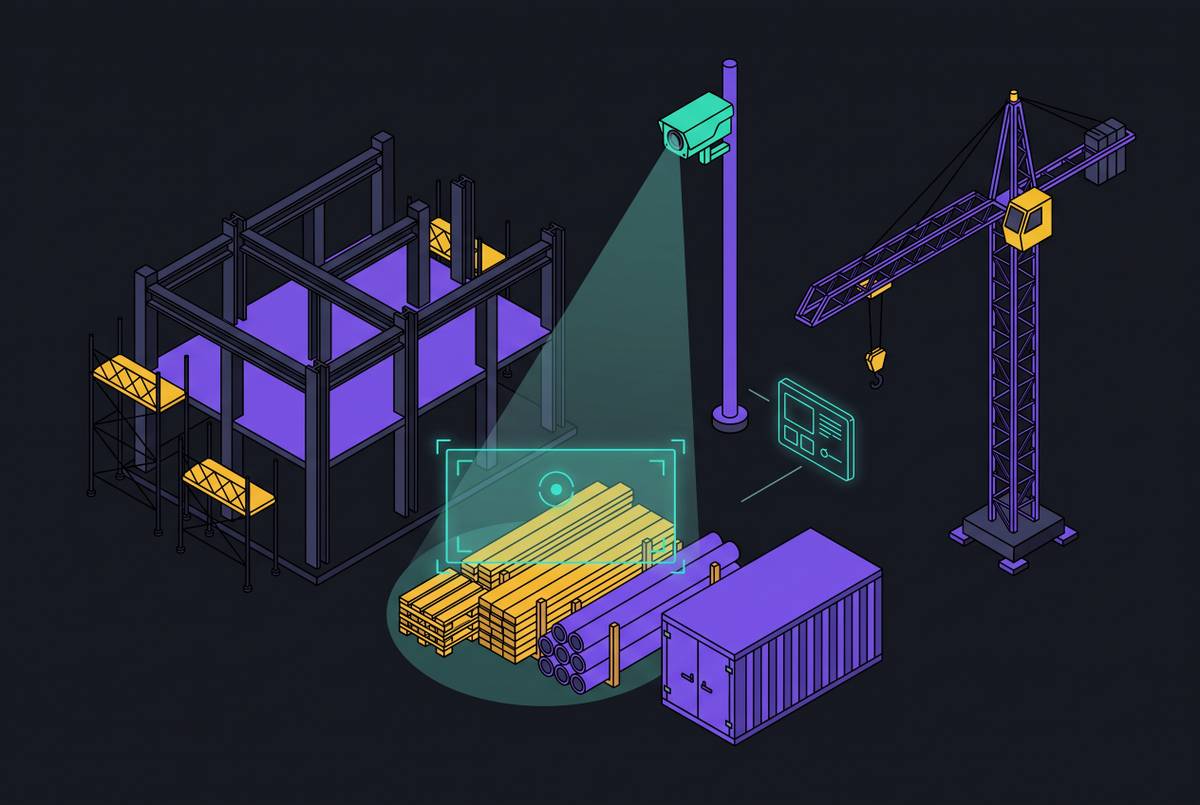
For a truck yard, a retail storefront, a multifamily property, or an employee parking lot, the stretch of time between a real threat showing up on camera and a verified response reaching dispatch is the window where loss actually happens. That window is set by how deep the queue is, not by where the operator sits.
The comparison commercial buyers should be making is between a monitoring setup that gets from detection to intervention in seconds and one where a backlogged queue, regardless of the operator's location, stretches that same gap to many minutes. At a retail lot or employee parking area, after-hours intrusions tend to run their course well within the time a real alarm can spend sitting in a crowded queue behind lower-priority events. An intruder does not wait for a human to finish reviewing the raccoon three alarms earlier in the line.
Many jurisdictions give video-verified alarms priority in police response, but that priority only kicks in once a human has actually verified the event and dispatched it. A queue delay pushes back the exact moment that triggers the priority response. The protection that verified alarms are supposed to carry gets delayed right along with the alarm itself. A lower monthly bill from an offshore monitoring center does not make up for a single theft or break-in that a faster response would have stopped. The savings only look real on paper, right up until the gap in coverage turns into an actual loss.
Muting, Offshoring, and Overage Pricing: the Same Flaw
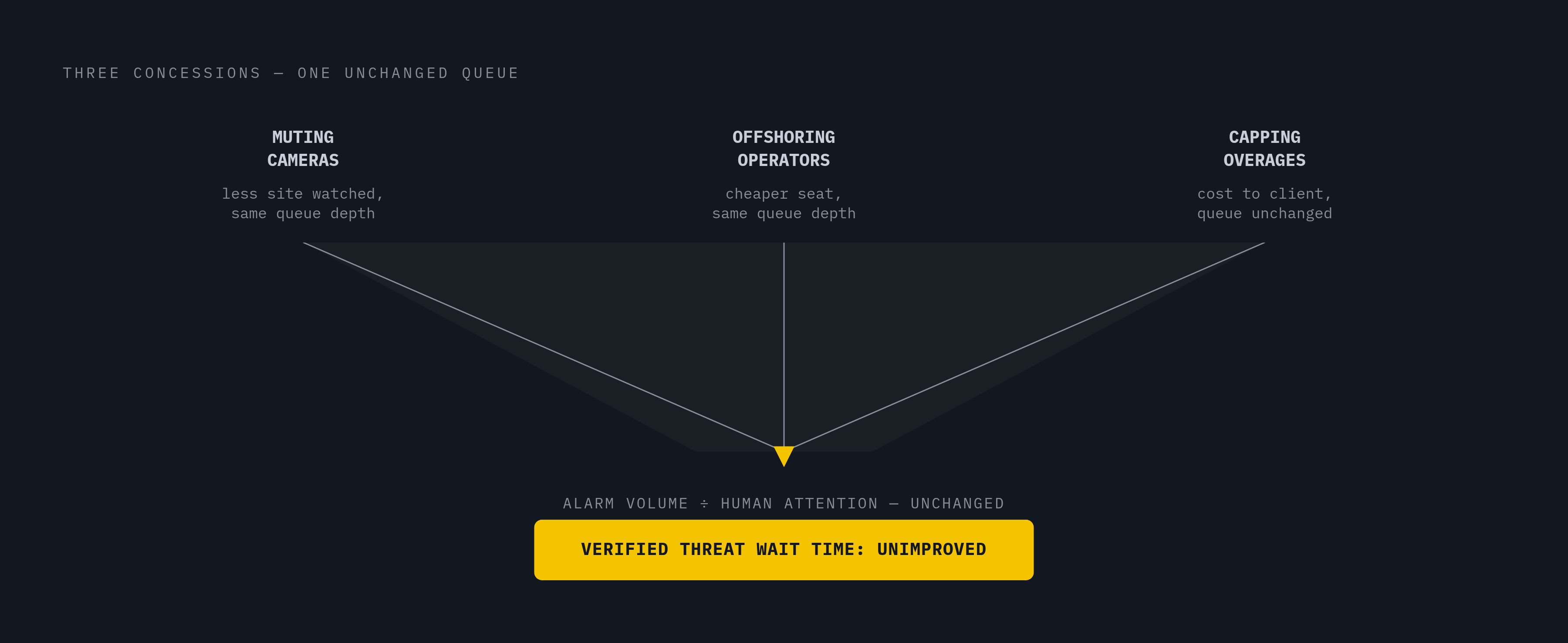
Three offers tend to appear together when a commercial buyer pushes back on cost: muting noisy cameras, moving monitoring offshore, and capping overage charges. They read as three separate concessions. They are the same response to the same pressure, repeated three times: make the alarm queue look smaller instead of fixing what fills it.
Muting or suppressing a camera that fires frequent alarms does cut down the operator's workload, but it does that by taking the camera out of effective coverage. The site gets cheaper to monitor because less of it is actually being watched. Overage pricing works differently but reaches the same outcome: it passes the cost of peak alarm volume onto the client without changing who reviews those alarms or how quickly, treating a flooded queue as a normal, permanent cost of doing business. Offshoring, as already shown, lowers the price of the operator seat while leaving the depth of the queue and the wait time facing a verified threat exactly where they were.
All three moves target what is visible, cost on an invoice or alarm count on a dashboard, rather than the actual mechanism driving the problem: the ratio between how many alarms arrive and how much human attention exists to review them. A buyer who has been pitched quieter cameras, cheaper overseas labor, and a cap on overage fees has been offered three different ways to pay less for less coverage, packaged as if it were smart cost management.
How AI Agents Change Alarm Review
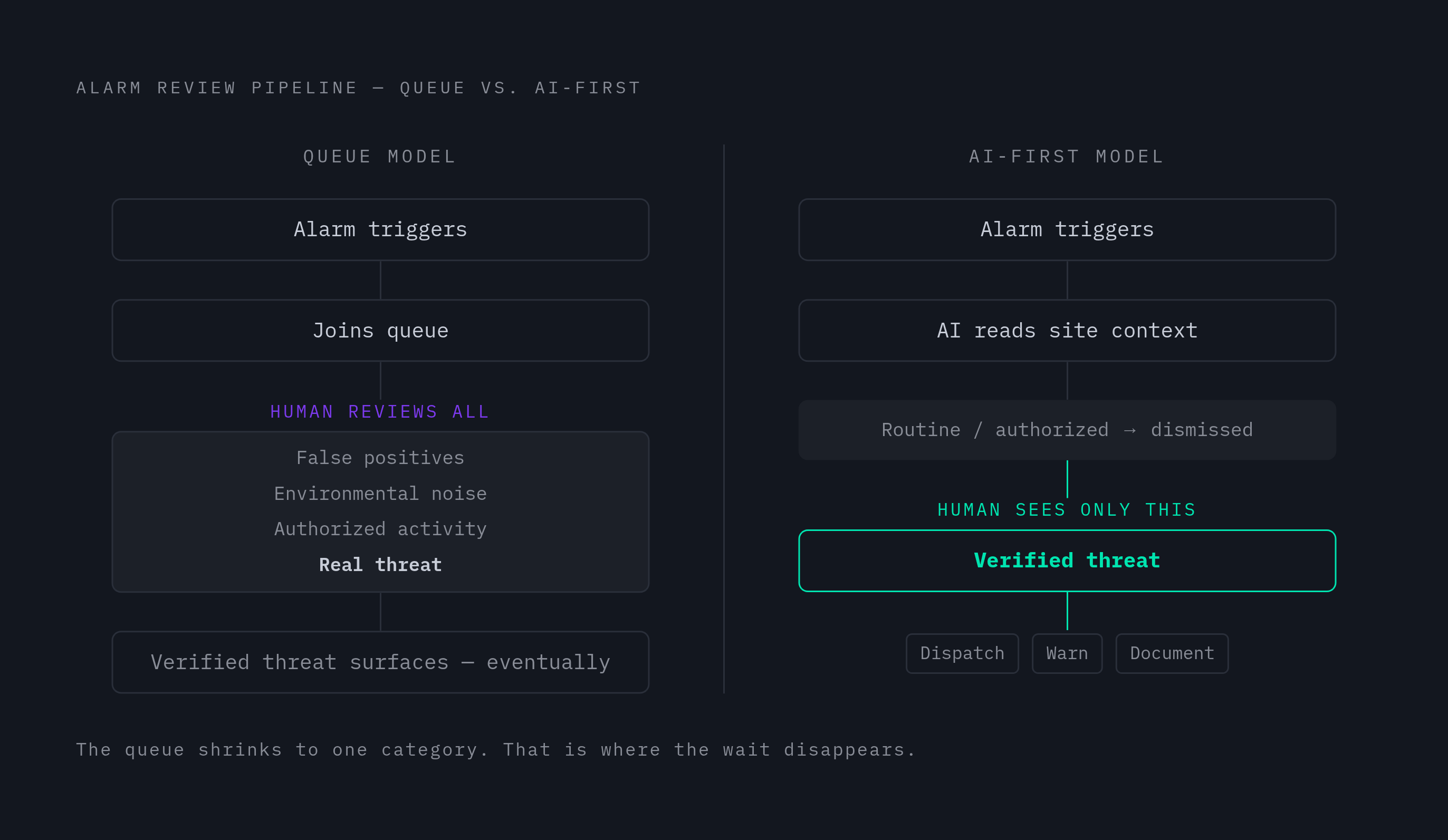
An AI agent reviewing every alarm first removes the ratio of alarms to attention that made the queue hard to manage. It dismisses environmental noise and authorized activity on its own, and sends only verified threats up to a human. At that point the human's queue holds only the events that actually require judgment, because everything else has already been sorted out before a person ever sees it.
The real shift here is in what the system is doing. A flagging system generates an alert and leaves a human to figure out what it means. A reasoning system looks at what's moving, how it's behaving, and whether that activity fits what's normal for that particular site, before a human gets involved. That distinction, reasoning instead of flagging, is what separates a system that actually cuts the queue down from one that just adds another layer of alerts for a person to wade through.
Site-specific context is what makes that reasoning worth anything beyond a generic trigger rule. Take a manager who disarms the alarm and walks in at 5:45 every weekday morning. A system that has learned that pattern recognizes the event correctly and does not send it anywhere. A system with no knowledge of that site has no way to tell that early-morning entry apart from an intrusion, so it either escalates it to a human or, worse, gets muted outright to stop the noise. Context is what lets a system make that call correctly on its own.
Once the AI layer is handling the bulk of the high-volume, low-complexity review work, authorized activity, routine environmental triggers, familiar patterns, the human operator is left with a much smaller set of events, and a much higher-quality one, that actually call for a person's judgment. None of this replaces the human decision at the center of monitoring. What it does is clear out the pile of non-decisions that was burying the human's ability to act on the ones that actually mattered.
The human operator's role in an AI-first monitoring workflow
Once AI is handling routine alarm review, the operator's job changes shape. Instead of working through a queue, they're exercising judgment on events that have already been confirmed as real. That's a harder job, not an easier one, and it produces more reliable outcomes than the queue model it replaces.
An operator working this way only ever sees escalated, verified events. Their attention is never spread thin by false positives or routine activity, cutting off the fatigue and desensitization that come from sheer volume at the source. What's left for the human to decide is whether to dispatch, how to talk to an on-site contact, whether an intercom warning makes sense in that moment, what gets written down afterward. These calls need context, legal awareness, and someone who can be held accountable for them, none of which a system can supply on its own.
Operators also pick up a second job: watching how the AI reasoned through the events it resolved by itself, catching cases where its judgment was off, and keeping site-specific protocols current as conditions on the ground change. That's a more demanding role than sorting through a raw alarm queue ever was. And when a live operator uses a speaker to warn off someone loitering on a property at night, that action still comes from a person even when the AI generated the trigger that brought the event to their attention. The human presence in the response doesn't go away. It gets aimed more precisely at the moments that call for it.
What this leaves a buyer to ask is what training operators get for this changed role, and how the provider manages oversight of the events the AI resolves without a human ever seeing them.
What a Commercial Security Buyer Should Evaluate
A provider's pricing model and the location of its operators say almost nothing about whether a real threat at a buyer's property will reach a trained human in time to matter. What matters is the specific set of questions a buyer asks before signing a contract, and most of those questions have nothing to do with price. The first is how long it takes, on average, from the moment an alarm triggers to the moment a human reviews a verified threat, a number entirely separate from system uptime, camera count, or how many operators a provider employs. The second is whether the AI layer doing the first pass actually reasons from site-specific context, things like authorized schedules, access rules, and known activity patterns, or whether it's running generic motion-trigger logic dressed up as something smarter. The third is what share of alarms the AI resolves on its own, and what happens procedurally when it can't make that call. The fourth is how operators are trained for the judgment calls that come after an AI escalation, and how the provider audits the activity the AI handled without a human in the loop. The fifth is whether the provider's service agreement sets response times by how severe an event is, or whether it only commits to keeping the system running.
A provider that can't give a specific, verified figure for how long it takes to get a verified threat in front of a human is very likely still running a queue-based model, no matter whether its operators are sitting down the street or on the other side of the world. The real benchmark is an AI-augmented setup that gets a verified threat to a trained human without the delay a queue would otherwise impose, since that's the structural fix offshoring was never built to deliver. And the clearest sign of whether a system actually works this way is its coverage of site-specific protocol: schedules, authorized users, partitioned zones, escalation rules. That coverage is what separates a system that correctly waves through a manager's early arrival from one that either drowns its operators in false alarms or quietly mutes the camera just to make the noise stop.