False Positive Rates and Operator Fatigue in Alarm Centers
High false positive rates degrade operators' ability to spot genuine threats amid alert fatigue.

Alarm centers built around a single human operator reviewing a queue of clips cannot keep pace with the volume modern camera networks generate, and the consequence is that real threats sit behind noise, waiting their turn. The core finding this piece traces: a false positive rate that makes up the overwhelming majority of alarms doesn't just slow a monitoring center down, it produces a measurable decline in an operator's ability to recognize a genuine threat when it finally appears. That decline is what happens when an architecture built for a trickle of alerts gets fed a flood.
Alarm centers built for humans cannot keep pace with alarm volume
Picture the queue itself: a line of clips stacking up on a monitor, each one waiting for a human to open it, watch it, and decide. A sensor trips somewhere on a property, a camera catches a few seconds of motion, and the clip lands in line behind however many others showed up in the last ten minutes. The operator works through them one at a time, in order, because that is the only mechanism a human-reviewed queue has ever had. When the number of clips entering that queue exceeds the number a person can review in the time available, the queue does not pause to let the operator catch up. It keeps filling.
Traditional video monitoring runs object detection on every camera connected to it, but it can't tell a person climbing a fence from a shadow crossing a parking lot at the same angle. The architecture treats every trigger as equally worthy of review. A real threat waiting in that line has no priority over the branch swaying in the wind three clips ahead of it. That is the predictable output of a system that routes everything through one human bottleneck and asks that bottleneck to sort signal from noise in real time.
A false positive rate that dominates the queue worsens the queue problem
A queue where nearly every alarm is not a real threat is a noise stream that occasionally contains a real event, and that distinction matters because it changes what the operator is actually doing all day. Reviewing a queue assumes that most of what arrives deserves scrutiny. A noise stream assumes the opposite: that most of what arrives can be dismissed, and the operator's job becomes finding the rare exception inside a sea of near-identical dismissals.
Vectra AI's 2026 analysis shows that alert volume has been declining, but the rate of unaddressed alerts hasn't improved, because signal quality, not count, is the structural problem. In video monitoring specifically, the mechanism driving this is straightforward: cameras trigger on motion, not on what that motion means. Every environmental change inside a camera's field of view becomes a task for the operator, and no amount of working faster closes a gap that wide. The ratio, not the raw count, is the problem that has to be solved.
The cognitive mechanism that turns high false positive rates into missed real threats
Alert fatigue describes a specific desensitization process, not a generic complaint about tiredness. Sustained exposure to overwhelming volumes of low-value alerts degrades an operator's cognitive response to all alerts, including the genuine ones buried among them. Vectra AI's 2026 guide confirms that the cybersecurity adaptation of this dynamic follows the same core pattern: volume exceeds capacity, desensitization follows, and real signals get missed as a direct consequence.
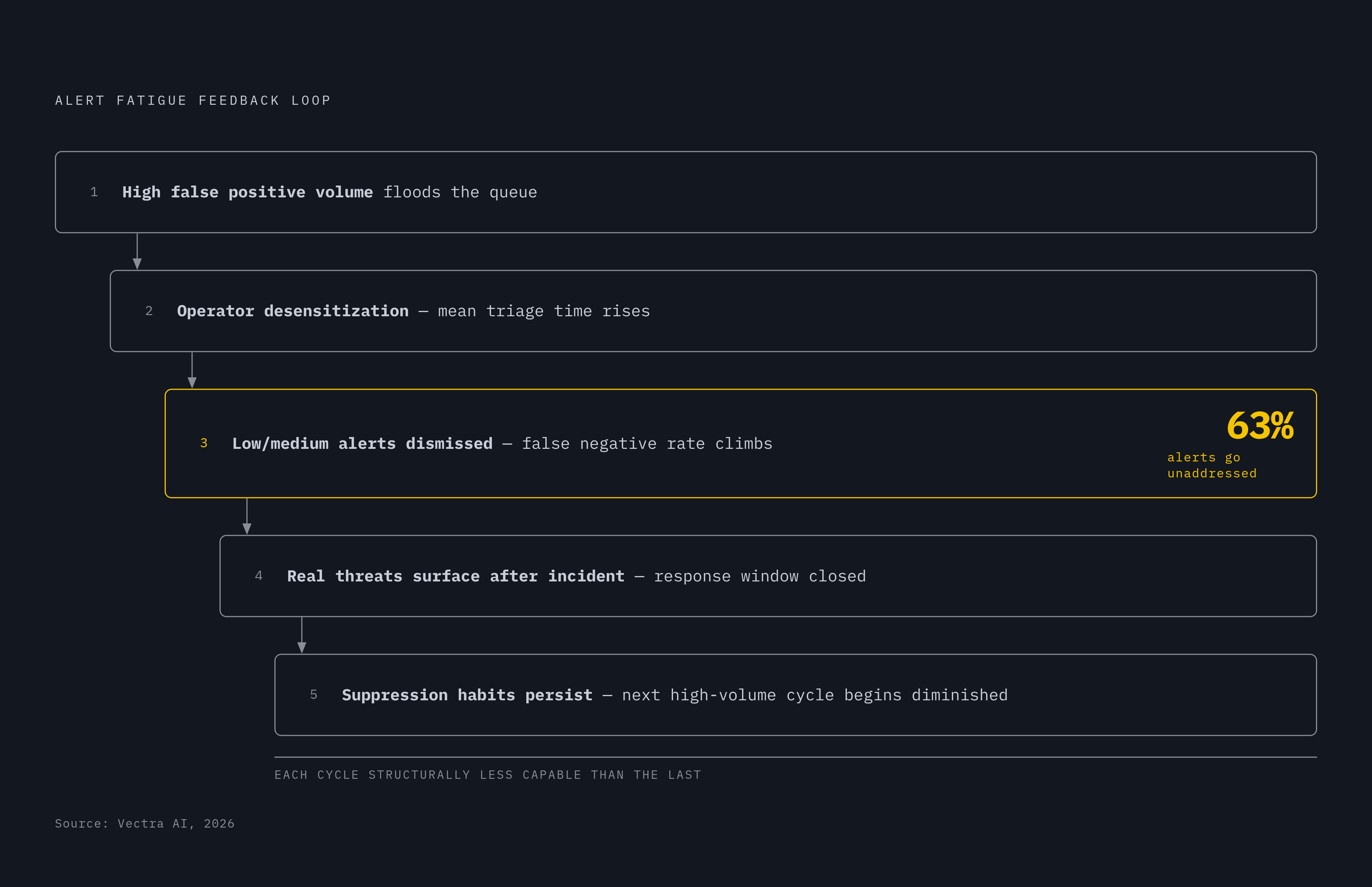
The signs of this process are observable and measurable. Mean time to triage rises. Analysts start dismissing low- and medium-severity alerts without investigating them one by one, so false negative rates climb, and genuine threats surface only after an incident has already happened, not during the window when a response could have stopped it. Vectra AI's 2026 analysis found that 63% of security alerts go unaddressed, a figure that stands as a direct measure of how fatigue translates into systematic non-response across an operation.
The obvious objection is that disciplined operators can be trained to maintain vigilance regardless of volume. Vigilance, though, draws on a finite cognitive resource, not an infinite one. It is rational Bayesian updating on the evidence directly in front of them: if the last two hundred alerts were nothing, the two hundred and first looks, statistically, like it will be nothing too. The architecture that generated those two hundred false positives produced that expectation, not the operator holding it.
The fatigue feedback loop at shift transitions and peak volume
Fatigue does not spread evenly across a working shift. It concentrates at the exact points where a monitoring center's design is structurally weakest: shift transitions and peak alarm windows, the moments when the system is already under the most strain.
An incoming operator inherits the same queue the outgoing operator was working, cold. There is no way to know which clips have already been reviewed, which sites have been unusually active, or what patterns the previous operator had started to notice before handing off. Response capability dips at precisely the moment a late-night or early-morning threat is statistically more likely to arrive, because the person now responsible for catching it is starting without the context the shift before them had built up.
That dip would be concerning enough if it reset at the start of each new shift, but research on false-positive suppression in detection rule repositories, along with fieldwork on security operations centers, shows that operators and analysts under volume pressure develop suppression habits: tuning out or dismissing alert categories that have been noisy in the past. Those habits do not disappear when an operator goes home. The result functions as a ratchet. Each period of high-volume false positives produces suppressions and desensitization that make the next high-volume period easier to tune out, until the monitoring system as a whole is structurally less capable of catching real threats than it was on the day it was first deployed.
Muting cameras, adding operators, and offshoring do not fix the queue
Security teams facing alarm volume tend to reach for three tools: muting high-noise cameras, adding operators, and offshoring the monitoring work to lower-cost labor. Each tool addresses a visible symptom while leaving the architecture that produces it unchanged.
Muting a noisy camera eliminates false positives from it by eliminating every positive signal from it as well. Silencing the camera stops the system from telling you about the branch and the burglar alike.
Adding operators scales the problem linearly. Doubling the size of a queue requires roughly doubling the headcount reviewing it, and each new operator added to the roster is subject to the identical fatigue dynamics as the operators already there. The feedback loop described in the previous section does not shrink because more people are inside it. It just has more people experiencing it.
March Networks' analysis of video surveillance false positives frames the alternative clearly: reducing false positives at the detection layer, before a clip ever reaches a human, changes the economics of operator attention rather than simply scaling up the supply of operators available to absorb it.
Reasoning layers versus detection layers
A detection layer flags that something moved. A reasoning layer assesses whether what moved constitutes a threat, given what the system already knows about that specific site. That distinction is where the generational shift in monitoring architecture actually sits, and it is a different kind of system than a detection layer tuned more aggressively or staffed more heavily.
Site-specific context is the variable that makes reasoning possible. An AI agent trained on a camera's real-world conditions, including lighting at different times of day, normal traffic patterns, objects that are always present in frame, and the schedules of authorized personnel, can classify a motion event against a known baseline. Verdun's agent-based verification approach works this way: the agent isn't asking "did something move," it's asking "does this match what's expected here, at this time, given this site's history."
So the queue that reaches a human operator arrives already filtered. Only events the reasoning layer cannot classify as authorized or environmental reach a person, so the operator's attention is applied to a smaller set of higher-quality signals rather than diluted across hundreds of clips that never needed human eyes. Verdun's architecture exemplifies why the queue itself has to change at the root: instead of routing every motion trigger through human operators, its AI agents filter environmental noise and false positives first and escalate only verified threats to trained staff, moving the bottleneck from the human cognitive layer to a system built to scale with alarm volume.
Site-specific protocols shape what a reasoning layer can decide
If a reasoning layer applies one uniform ruleset across every site it covers, it runs into the same mismatch problem a generic detection threshold does. It cannot tell authorized activity from unauthorized activity, because it has no definition of what authorized looks like at that particular property.
Protocol specificity is what corrects for that. At a truck yard, authorized activity can include vehicles moving after hours on certain days of the week. Without a definition specific to the site, a reasoning layer has no basis for a meaningful decision, and it either over-triggers on normal activity or misses genuine deviations from it.
If you encode arming schedules and response rules per site, then when an event comes up for review, the agent checks it against that property's actual operating context, not a generic policy applied uniformly across a portfolio. The protocol also governs what happens once a threat is confirmed: predefined response steps, including live talk-down, coordinated dispatch with location and footage attached, and notification to on-call contacts, produce a specific action chain rather than an improvised response assembled under pressure.
In commercial and industrial settings, this protocol layer extends well past simple intrusion detection. Loading dock Door Forced Open and Door Held Open alarms, forklift entry into pedestrian zones, and PPE compliance events each require their own site-specific definition of what counts as an anomaly before any reasoning about them is valid.
Verified response and its effect on law enforcement dispatch and real-world outcomes
The architectural fix matters most in the moment a real threat gets confirmed. A verified alarm, reviewed and confirmed in progress by a human operator, changes how law enforcement prioritizes the dispatch that follows.
Many cities now require video, audio, or eyewitness confirmation before police will respond to a commercial alarm, and some fine a property or suspend its response privileges after a pattern of repeat false alarms. A high false positive rate from a legacy monitoring system is therefore not confined to an internal efficiency problem. It degrades a property's access to emergency response when an actual incident occurs.
Delays traditionally accumulate at the verification step: a monitoring center waits on a callback while a staff member assumes dispatch has already gone out, and the gap between detection and actual response widens in the meantime. Site-specific protocol coverage closes that gap by defining in advance exactly who notifies whom, and in what order, so nobody is improvising the chain of custody for an alarm while an incident is still unfolding. Verdun's model compresses that chain directly: AI agents verify first, trained operators respond only to confirmed threats, and dispatch goes out with location, footage, and context already attached, so the operator receiving the escalation is not starting from zero when seconds matter.
A monitoring architecture designed to catch real threats rather than manage queue volume
The alternative to a human-bottlenecked queue is a layered system: AI agents handle continuous attention and contextual filtering, and human operators handle verified threat response. These two roles are not in competition with each other, since each operates at the layer where it performs best, and the system as a whole benefits from keeping them separate.
The defining property of this kind of architecture is that operator cognitive load stays bounded. Because only verified threats reach a human, attention is never diluted by hundreds of clips of wind and shadow, and fatigue has no chance to accumulate from processing noise before a real signal finally appears. The Bayesian dynamic described earlier, where an operator reasonably expects the next alert to be another false positive after a long run of them, is not something training can fix, because it is a correct response to a flawed input stream. Systems built to remove that noise cascade entirely preserve human judgment as the scarce resource it actually is, reserving it for genuine threats and keeping it away from triage.
Because fatigue concentrates exactly at the moments when monitoring capacity matters most, the traditional model of scaling response through added headcount runs into its own limit. AI-first monitoring services that pre-filter alarms before they reach a person can sustain consistent response speed through peak volume windows and shift changes alike, decoupling the quality of threat detection from how many operators happen to be on shift at a given hour.
Camera count has never been the right measure of monitoring quality. What matters is that every camera's output gets reviewed with actual intelligence behind it, with the humans in that chain positioned to act on confirmed threats. The real question for any monitoring provider is what path an alarm travels from detection to a human decision, and at which points along that path the noise gets filtered out before it reaches a person.