Peak Hour Coverage Gaps in Traditional Monitoring Centers
AI agents filter noise before human operators see it, solving peak-hour coverage collapse.
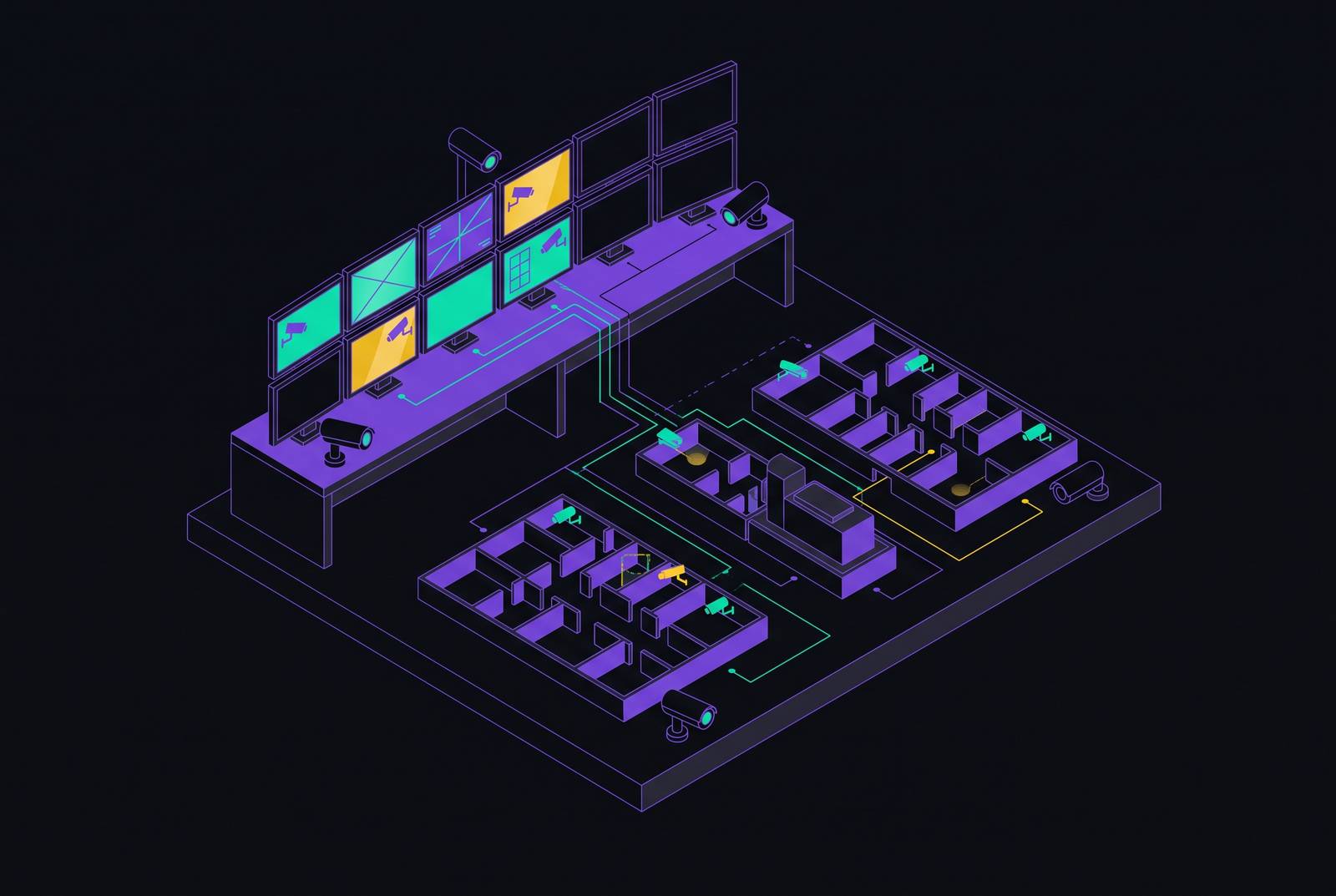
Peak-hour coverage collapse in traditional monitoring centers is an architectural inevitability, not a staffing shortfall that better hiring or scheduling could correct. When alarm volume, the vigilance decrement, and false-positive noise compound simultaneously, the sequential queue model guarantees that real threats wait behind noise precisely when they are most likely to occur. The only structurally sound answer is to filter alarms before they reach a human operator, and AI agents are the first technology positioned to do that at scale.
Why Peak-Hour Alarm Surges Overwhelm Monitoring Centers Structurally, Not Operationally
On a busy Friday night close, an alarm gets to a monitoring center. A retail store's back door opens for the last departure, a motion sensor trips near a loading dock, and a perimeter camera catches movement from a delivery truck pulling away. Each event becomes a clip, and each clip enters the same queue. The operator on duty processes them in the order they arrived, one after another, while more alarms continue to arrive from dozens of other sites across the center's portfolio. The question that determines whether anything meaningful happens is not how hard the operator works. Two compounding forces decide it: the total volume arriving at the queue and the rate at which a human operator can clear it. At peak hours, those forces move in opposite directions.
Peak hours are the windows when alarm density spikes highest and when real threats are most likely to occur. Shift changes, retail closings, and after-hours activity at multifamily and industrial sites all fire at once. The architecture itself, not the operator's performance, determines the outcome.
How Human Attention Limits Turn High Alarm Volume into a Coverage Gap
Peak-hour alarms have not fired yet, but an operator's ability to detect real threats is already degrading. An operator working into their second or third hour of a shift is already operating at materially reduced detection capability before the queue begins to build.
The empirical evidence makes the ceiling concrete. The study subjects were experienced operators, and experience does not override a physiological ceiling. This is a capacity problem, not a knowledge problem.
The perceptual load compounds when an operator monitors dozens of feeds simultaneously rather than one. The human visual system was not built to process that much simultaneous, low-signal information, and the degradation is multiplicative rather than additive. The conditions under which peak-hour threats most often arrive, late evening and overnight, are the conditions under which operator attention is most compromised.
Why Muting Noisy Cameras Is Not a Monitoring Solution
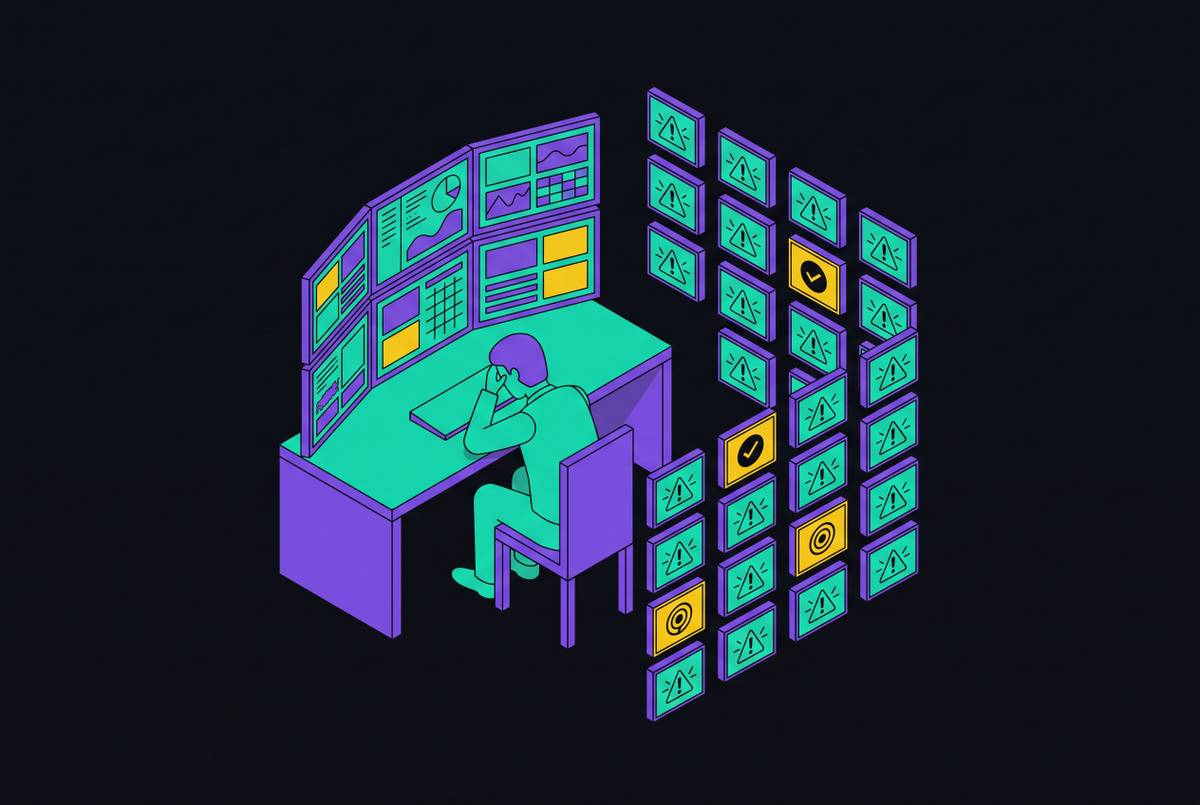
High false-positive rates do not simply waste operator time. They teach operators to treat the entire alert queue as unreliable, which is the rational response to a broken signal-to-noise ratio. Security Journal Americas has documented that the overwhelming majority of this stream is noise. A queue that never stops growing, filled mostly with meaningless events, produces a predictable adaptation.
Operators learn to treat all alerts with less urgency, and they learn it quickly. A two-year veteran and someone six weeks into the job arrive at the same adaptation because it is the logical response to the signal environment they are in, not a personal failing. The instinctive organizational response to this flood is to raise detection thresholds and reduce alert volume. Real events get suppressed along with noise, so compliance gaps and missed incidents surface only in post-event audits.
The external cost is equally significant. The U.S. Department of Justice COPS Office has documented that a large majority of police alarm calls are false, straining law-enforcement relationships and eroding the credibility of verified dispatches from monitoring centers. Alert fatigue began in cybersecurity SOCs, where peer-reviewed ACM survey research identifies it as a documented structural failure mode, and it applies with equal or greater force to physical surveillance operations. Verdun's architecture addresses it by having AI agents filter environmental noise and authorized activity before any alert reaches an operator's queue, so operators see only events that warrant human judgment rather than learning to dismiss the entire signal as unreliable.
The Queue Math That Guarantees Real Threats Wait Behind Noise at Peak Hours
When alarm volume, the vigilance decrement, and false-positive noise compound simultaneously, which is exactly what happens at peak hours, the queue math guarantees that real threats are buried. This is not an accident of staffing. It is arithmetic.
The mechanism operates step by step. Peak-hour alarm density spikes as retail closings, shift changes, and after-hours industrial activity all fire simultaneously. A real threat arriving at the back of that queue waits, not because no one is watching, but because the architecture offers no mechanism to surface it ahead of the noise that arrived first.
The result is a response delay measured not in seconds but in many minutes. More operators reduce the average wait time marginally, but they do not change the architecture that allows real threats to wait behind noise at all. This is why services like Verdun bypass the queue altogether: AI agents review every alarm first, dismiss noise, and escalate only verified threats to human operators, so a real threat reaches a person in under 90 seconds rather than waiting behind dozens of false positives.
Why the Legacy Industry's Fixes Leave the Queue Problem Intact
The three most common industry responses to peak-hour overload each address a symptom while leaving the queue architecture untouched. Muting noisy cameras reduces alert volume by removing cameras from the monitored set, which is the false-positive-to-false-negative conversion in its most literal form. The camera still exists and the footage still records, but the coverage promise is quietly voided without the client knowing.
Offshoring operators reduces labor cost per operator seat and can extend coverage hours, but it does not change the clearance rate per operator or the queue logic that forces real threats to wait behind noise. Without that context, an operator cannot meaningfully filter. They escalate everything or nothing.
Overage pricing transfers the financial cost of peak-hour alarm volume to the client without reducing it. The loop closes back to the first false fix. All three keep the sequential queue model, so all three keep the architecture that buries real threats.
What Site-Specific Context Does to Alarm Quality
Alarm noise is not random. Much of it is authorized, predictable activity that a system with site-specific context would never surface as an alarm. A generic motion trigger cannot tell a cleaning crew on a known overnight schedule from an unauthorized intruder. An operator without that schedule in front of them cannot filter it either.
Site-specific protocol determines which of several response paths is actually appropriate: live audio intervention, contacting on-site personnel, dispatching a guard resource, escalating to law enforcement, or dismissing the event as authorized, as described by Blue Eye Monitoring. Without encoded site context, including schedules, authorized activity windows, facility maps, and known vehicle lists, every alarm arrives at the operator without the information needed to make that determination efficiently. The operator either spends time reconstructing context, which slows clearance rate further, or makes a low-confidence call, which increases false positives or false negatives.
For peak-hour queue math, the implication is direct. Sites with rich encoded context generate materially fewer noise alarms, which reduces the queue that real threats have to wait behind. Context is not a luxury feature. It is a prerequisite for the queue to be manageable at all.
How AI Agents Change the Queue by Filtering Before Alarms Reach a Human Operator
The queue problem is solved not by adding operators or reducing thresholds but by ensuring that only verified, contextually meaningful alarms reach human operators in the first place. AI agents are structurally positioned to fill that role. AI agents also pre-package verified events with location, video clip, incident classification, and response options, so a human operator receives actionable intelligence rather than a raw alarm signal requiring reconstruction. The filter effect on queue math is substantial. VideoraIQ's analysis of surveillance deployments describes the workflow that matters: the moment a threat is detected, the security team receives an attached video clip, location tag, and timestamp, delivered fast enough that the intervention window remains open.
The design principle is critical: AI handles filtering, not reacting. The human operator remains the decision-maker for every verified escalation. It is a division of labor that plays to what each does well: continuous, tireless attention from the AI. Judgment, discretion, and accountability from the human. Verdun's model operationalizes this division precisely, with AI agents reviewing every alarm first, dismissing noise and authorized activity, and surfacing only verified threats to trained human operators who then target under-90-second response to a verified threat rather than the 20-plus minutes a legacy queue produces.
What Faster, Higher-Quality Escalation Means for the Sites That Carry the Most Peak-Hour Risk
The sites most exposed to peak-hour queue failure are precisely the sites where after-hours threats are most consequential and time-sensitive. Retail stores, employee parking lots, truck yards, and multifamily properties all see incidents play out in minutes. Retail closing time is among the highest-density alarm periods. Multiple zones fire simultaneously, multiple motion events register, and authorized staff departures can be mistaken for unauthorized entry. A theft or organized retail crime event that completes in 10 minutes cannot be addressed by a monitoring center that takes 20-plus minutes to reach it in a queue.
Employee and truck yard lots face a high-value, low-visibility threat. After-hours access by unauthorized vehicles occurs at dark sites across large areas, and the alarm signal from motion near a fence or gate is identical to a delivery truck making a late authorized drop. With it, the AI agent can dismiss the authorized drop and escalate the unauthorized vehicle immediately.
Multifamily properties present a different version of the same problem. Overnight incidents such as package theft, unauthorized access to parking structures, and common-area disturbances occur during periods of low ambient activity that should, in theory, make them easy to detect. In practice, a monitoring center managing dozens of multifamily properties simultaneously concentrates its overnight alarm load in the same queue, and the math of per-operator clearance rate applies regardless of how quiet any single site appears. Industrial and construction sites active in low-light, changing-weather conditions are difficult to secure with traditional motion analytics. A client who believes their site is covered because cameras are installed and a monitoring contract is signed may not know that their peak-hour alarms are waiting 20-plus minutes in a queue until the incident report arrives.
What Buyers Should Actually Ask When Evaluating Whether a Monitoring Center Can Cover Peak Hours
The question a buyer should never accept a vague answer to is what happens to an alarm when it arrives at a monitoring center during a peak period. The following questions expose the architecture. What is the average time from alarm receipt to human review, not to dispatch, but to the moment a trained human looks at a verified event? The answer reveals whether the center uses a queue model, which is subject to the math described in this piece, or a pre-filter model, where AI reviews before the human queue.
What site-specific context is encoded into the system before monitoring begins? Schedules, authorized activity windows, known vehicles, and facility maps all matter. A vendor with no onboarding process for site context cannot filter meaningfully. Every alarm looks the same to their operators. The answer exposes whether the vendor is converting false positives into false negatives to manage their own operational load.
What does the vendor charge when alarm volume exceeds a baseline? Overage pricing is a signal that the vendor's model is not designed to absorb peak-hour load. The cost of the architectural failure is being passed to the client.
A structurally sound answer looks like this: AI agents pre-screen every alarm, site-specific context is encoded at onboarding, only verified threats reach human operators, and response time to a verified event is measured in seconds rather than minutes. The AI-agent-plus-trained-human-operator model exists specifically to ensure that peak-hour alarm surges do not create a queue that buries real threats. The monitoring promise holds not just in normal conditions but in the conditions where it is hardest to keep.