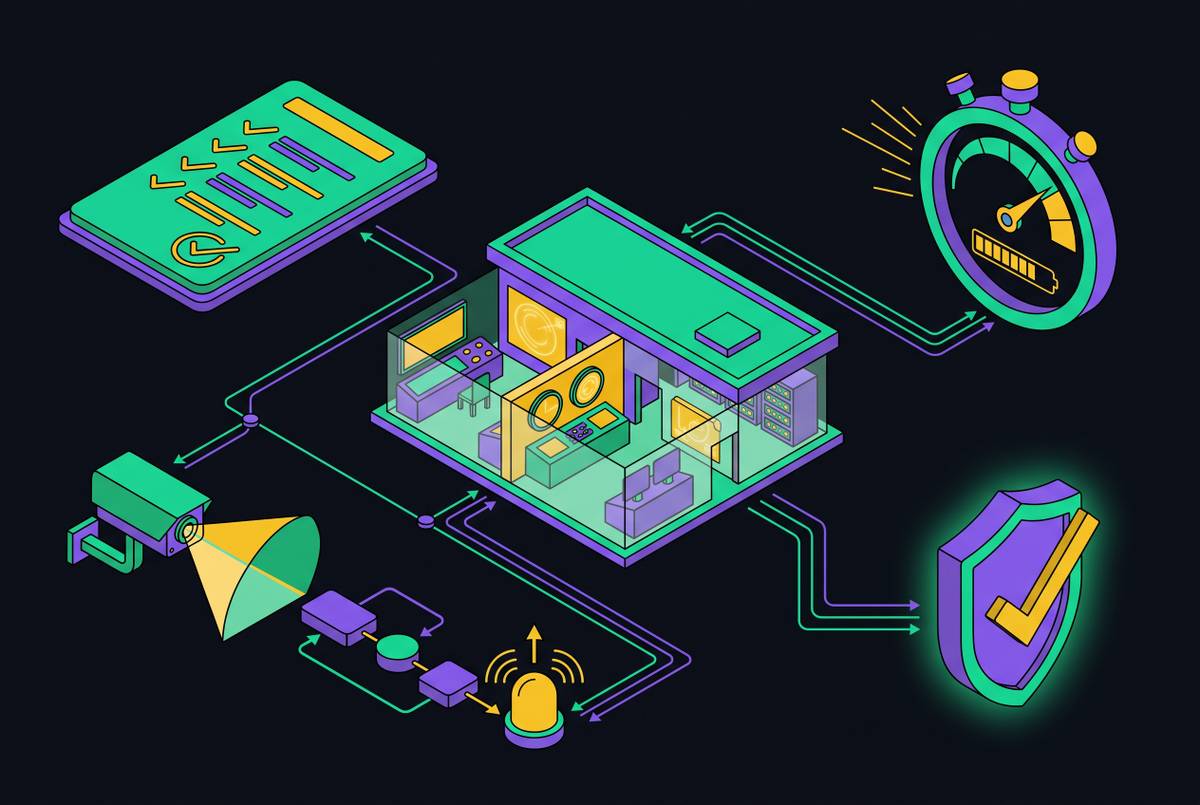
Video Verification vs. Audio-Only Alarm Response
Video and audio each reveal different threats, shaping how operators assess risk.
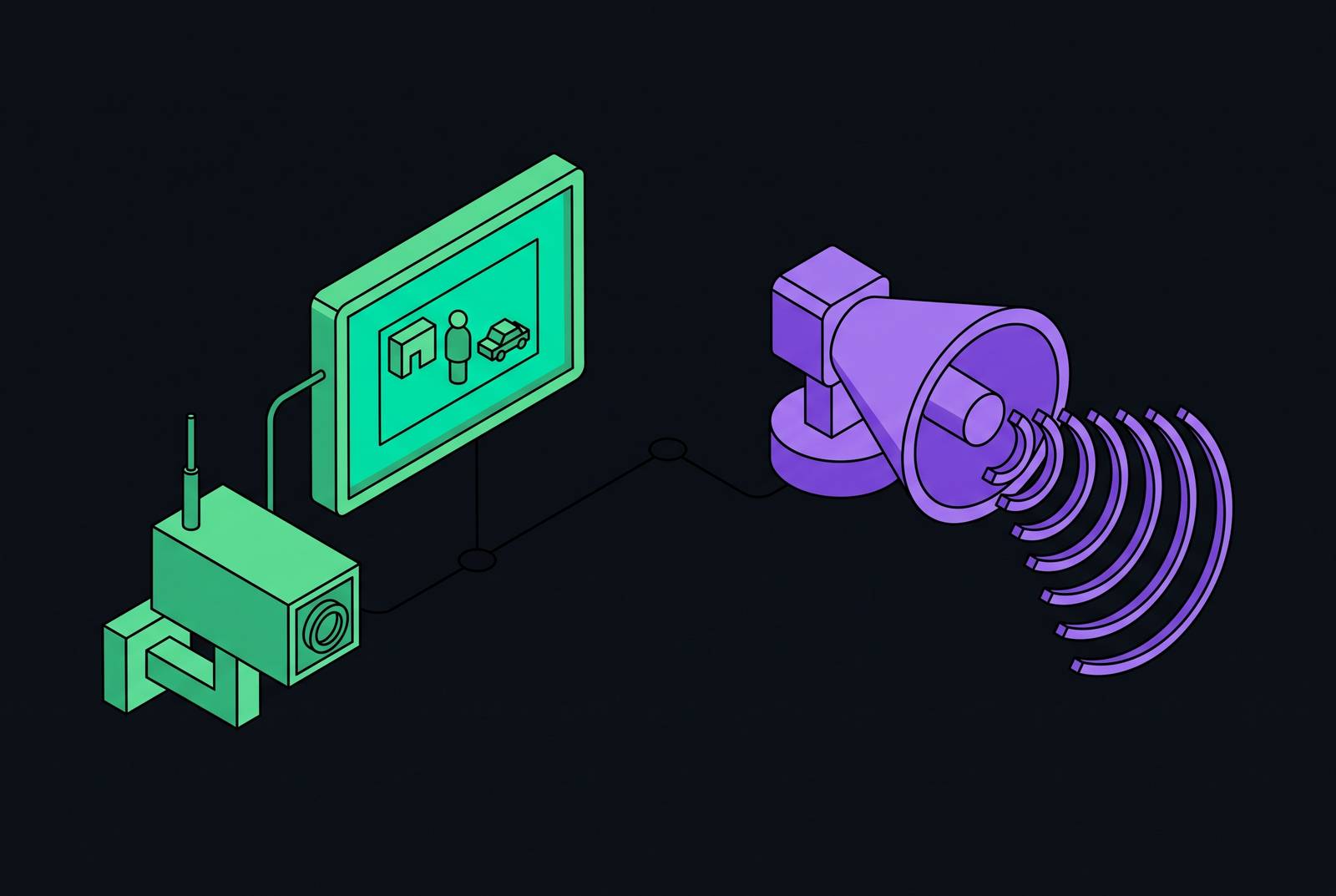
Muting noisy cameras is not a monitoring solution because it removes notifications from those cameras without distinguishing false alarms from genuine threats. Video Verification vs. Audio-Only Alarm Response examines the alternative, which is to improve what an operator knows before dispatch. Audio gives evidence of activity, while video shows what is happening and can help with threat classification. The goal is fewer unverified alerts reaching operators while maintaining security coverage.
Why the gap between detecting an alarm and knowing what triggered it defines the entire response
A sensor activation provides detection by establishing that something happened, while interpretation establishes what happened. A sensor may work exactly as it should while the monitoring operator still cannot tell whether anyone needs to respond. The failure is then not a missed activation but an unresolved event.
Traditional alarm monitoring follows a relay model in which a sensor trips, a signal reaches a monitoring center, an operator calls the premises, and dispatch follows. Until verification occurs, the chain advances on an unverified signal. An intruder, a balloon, and a rattling door can therefore enter the same response queue without a reliable distinction between them. The operator must resolve that ambiguity before assigning urgency, or pass it to the next person in the chain.
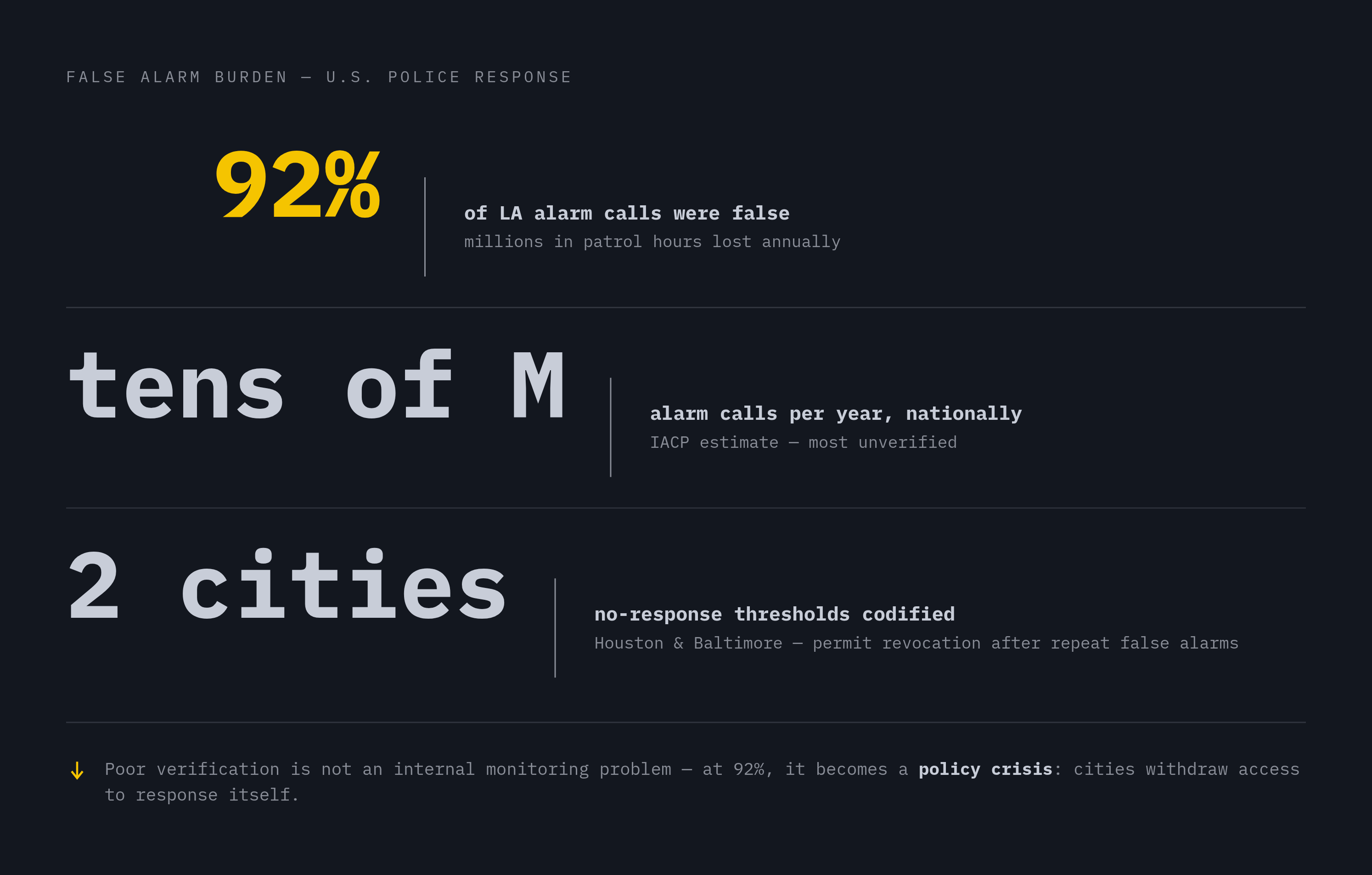
The ASU Center for Problem-Oriented Policing has gathered research showing that the vast majority of police responses to burglar alarms are for false activations. Ambiguity is therefore not an occasional exception to an otherwise clear workflow. It is an operating condition that affects how signals are assessed and whether responders trust them.
What an operator can and cannot determine from an audio-only alarm
Real-time listen-in can reveal voices, movement, breaking glass, or silence, each of which changes the assessment. Audio can also capture activity beyond a camera’s field of view, including spaces where no camera was placed. Audio analytics may pick up a threatening sound before a person enters a camera frame or trips a motion zone. Its value is therefore not limited to confirming an event that another device has already detected.
Movement alone does not tell the operator whether an authorized employee is working late or an intruder is entering the premises. Because sound carries through walls and across zones, it may not locate the activity precisely. Nor does sound alone provide visual object classification, which would establish whether a person, an animal, a vehicle, or environmental interference caused the activation.
The operator must instead infer how likely the sound is to represent a threat. Operationally, that means assigning a probability to competing explanations and using that assessment to determine dispatch urgency. The judgment may be well informed, but it remains different from seeing the triggering activity. Audio answers whether something can be heard and whether it sounds threatening, without necessarily establishing who is present, where they are, or what they are doing.
What video verification adds to the operator's picture and how it changes the dispatch decision
An operator can distinguish a person from an animal, a vehicle, or debris when the triggering activity is visible. That classification narrows the possible explanations before a call is made or a responder is dispatched. It changes the starting point from an unidentified activation to an observable event.
The next distinction is behavioral. A person moving toward a restricted area is doing something different from someone following an authorized route. A known delivery vehicle also carries a different meaning from an unfamiliar vehicle, provided the monitoring system has the relevant site knowledge. Pre-alarm clips can show how the situation developed before the sensor tripped. A live feed then allows the operator to assess its development over time.
Together, those views can support an affirmative account of unauthorized activity, while sound alone supports a probability. Telsco describes visual confirmation of an intrusion in progress as enabling authorities to dispatch with increased urgency. That does not make audio irrelevant, since sound can reveal activity outside the available image. Video’s particular contribution is to make the visible cause and behavior available at the moment the operator decides whether to dispatch.
How the false alarm rate shapes operator behavior long before any individual alarm arrives
Repeated exposure to ambiguous signals that prove harmless encourages the expectation that the next signal will also be false. Response quality can degrade as review thresholds shift and urgency declines. A genuine threat then inherits the skepticism created by earlier false activations.
Alarm fatigue has been studied in hospital ICU monitoring, where excessive alarms can produce desensitization and improper alarm management. The same process helps explain what happens in security monitoring, though it does not measure how well security monitoring works. The International Association of Chiefs of Police data shows that police get tens of millions of alarm calls each year. At that scale, treating noise as a staffing problem leaves the underlying signal quality unchanged. Operator skepticism is an adaptation to the workload.
Institutions also adapt by restricting the response available to alarm systems. The City of Houston’s Burglar Alarm Administration provides for permit revocation and no police response after repeated false burglar alarms. Baltimore City Code establishes a no-response threshold for repeated false alarms as well. These policies make poor verification more than an internal monitoring problem, because it can affect access to police response. Muting a high-alert camera may reduce the visible workload, but it does not help separate false alarms from genuine threats and can remove genuine threat notifications with the false ones.
How can security teams handle alert fatigue without turning off camera notifications through upstream AI filtering
Rather than forwarding every motion activation, the system analyzes what caused it and separates classified events from environmental noise. Relevant distinctions include people, vehicles, animals, rain, shadows, and vegetation movement. The intervention changes the workflow by processing events before they consume human attention.
Verdun addresses this interpretation gap by routing every alarm through an AI agent that reviews video footage before escalating a threat to a human operator. In this architecture, classification reduces the ambiguity that otherwise places routine activity and possible intrusions in the same queue. Site-specific knowledge can refine the distinction further. The same activity may be authorized during business hours but require attention at 2 a.m. in a restricted area. Unlike muting a camera, event-level filtering aims to distinguish what should be suppressed from what should reach an operator.
That distinction is only useful if the filter makes it reliably. A system trained on historical site data may misclassify a novel or rare intrusion pattern as environmental noise and suppress it before human review. AI therefore does not eliminate the possibility of a missed threat. Its proper role is classification and suppression of known-false signals, while trained humans assess escalated events and decide on dispatch. Both layers are needed, and humans can review only the events that reach them.
How verification method determines response speed and police dispatch priority
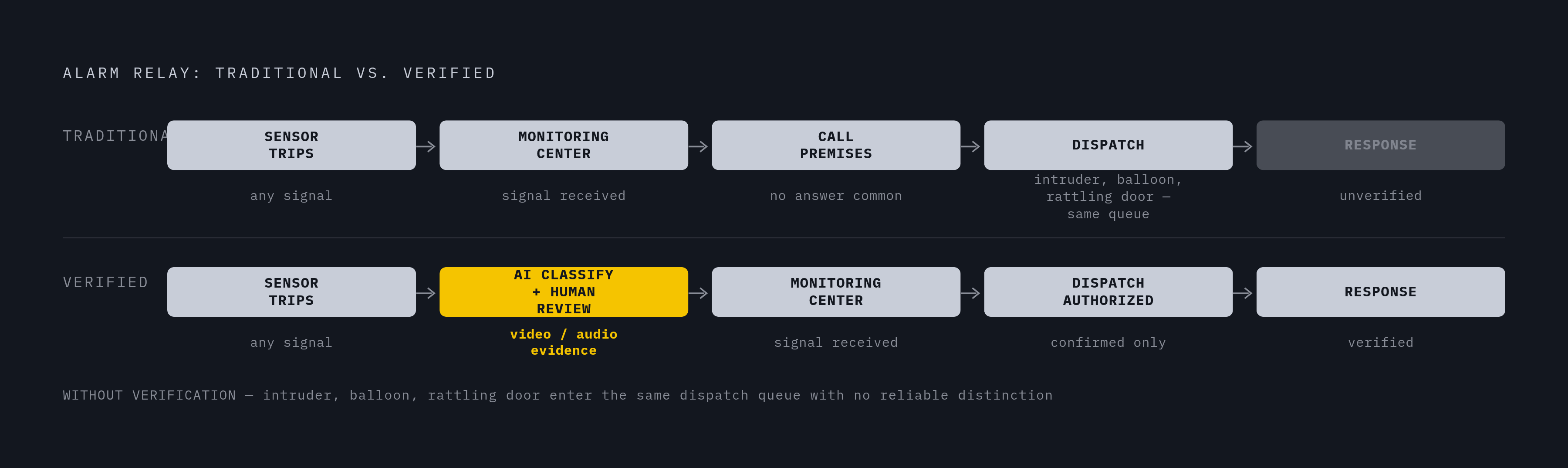
Verification can shorten the path to an appropriate response even though it adds an assessment step. An unverified alarm asks the operator and police to act on unresolved uncertainty. A verified event gives them an account of observed activity and a basis for assigning urgency. The important distinction is not simply how quickly a signal is forwarded, but how quickly useful evidence reaches the person authorizing a response.
Los Angeles moved to require verification after finding roughly 92 percent of its annual alarm calls were false, costing many millions of dollars in lost patrol time. Las Vegas pioneered verified response in 1991, and Salt Lake City was among the first major U.S. cities to adopt it. The Salt Lake City Police Department said alarm responses fell sharply as soon as verification was required.
Upstream classification also changes the operator’s starting point because the event has already been assessed as warranting attention. In AI-powered monitoring services such as Verdun, video review occurs before human escalation, so the operator is not beginning with an unclassified motion signal. This can compress initial assessment, but it does not establish a universal police response time or guarantee immediate dispatch. Local policy and the false-alarm history at an address still matter. A system’s credibility is an operational asset, and repeated false dispatches can erode it even when a later threat is genuine.
Where site context makes verification meaningful or unreliable
Visual evidence is not self-interpreting. A camera can show a person clearly without establishing whether that person is authorized to be there. Likewise, an operator can see a delivery without knowing that it was scheduled after hours. Verification is useful when what is seen is checked against the site’s schedules, authorized personnel, restricted zones, and usual ways of working.
Physical deployment sets an earlier limit. The triggering activity’s visibility depends on camera placement, obstructions, lighting conditions, and maintenance state. A camera that cannot see a point of entry cannot verify activity there, regardless of the sophistication of its analytics. Audio may give evidence from beyond that field of view, but it cannot supply the missing image. The resulting assessment must reflect what the system can actually observe.
At multifamily and mixed-use properties, after-hours tenant activity can produce false dispatches when monitoring lacks knowledge of who may use each space and when. Warehouses and perimeter sites present a different classification problem, where vehicle movement, wildlife, and weather must be distinguished from intrusion. Without site-specific training data, a classifier can overflag or underflag activity according to its baseline assumptions. Site protocol must therefore be part of verification from the start.
What the comparison between audio-only and video verification means for how a security buyer should evaluate monitoring
A buyer’s evaluation should begin with the evidence available at the dispatch decision. Audio-only monitoring is a legitimate way to detect and assess activity, including activity cameras cannot see. Its limitation is that the most consequential judgment may still depend on an inference about the source of a sound. Video can close that gap when the triggering activity is visible and its significance is understood.
If everyday activity sends a stream of clips for humans to review, genuine threats still compete with noise for attention. Muting those cameras addresses the queue by withdrawing notifications. The more useful distinction is between suppressing a classified non-threat and suppressing a camera’s alerts regardless of what happens in its view. Only the former attempts to reduce workload while retaining threat escalation.
Verdun’s model is relevant as one example of this division of work, with AI agents reviewing every alarm, dismissing environmental noise and authorized activity, and escalating verified threats to human operators. The buyer’s criteria are speed to verified human review of a genuine event and the site knowledge that makes the review meaningful.