The Moment an Alarm Queue Stops Being a Delay and Becomes a Dead Zone
Queue depth determines intervention window, not operator count alone.
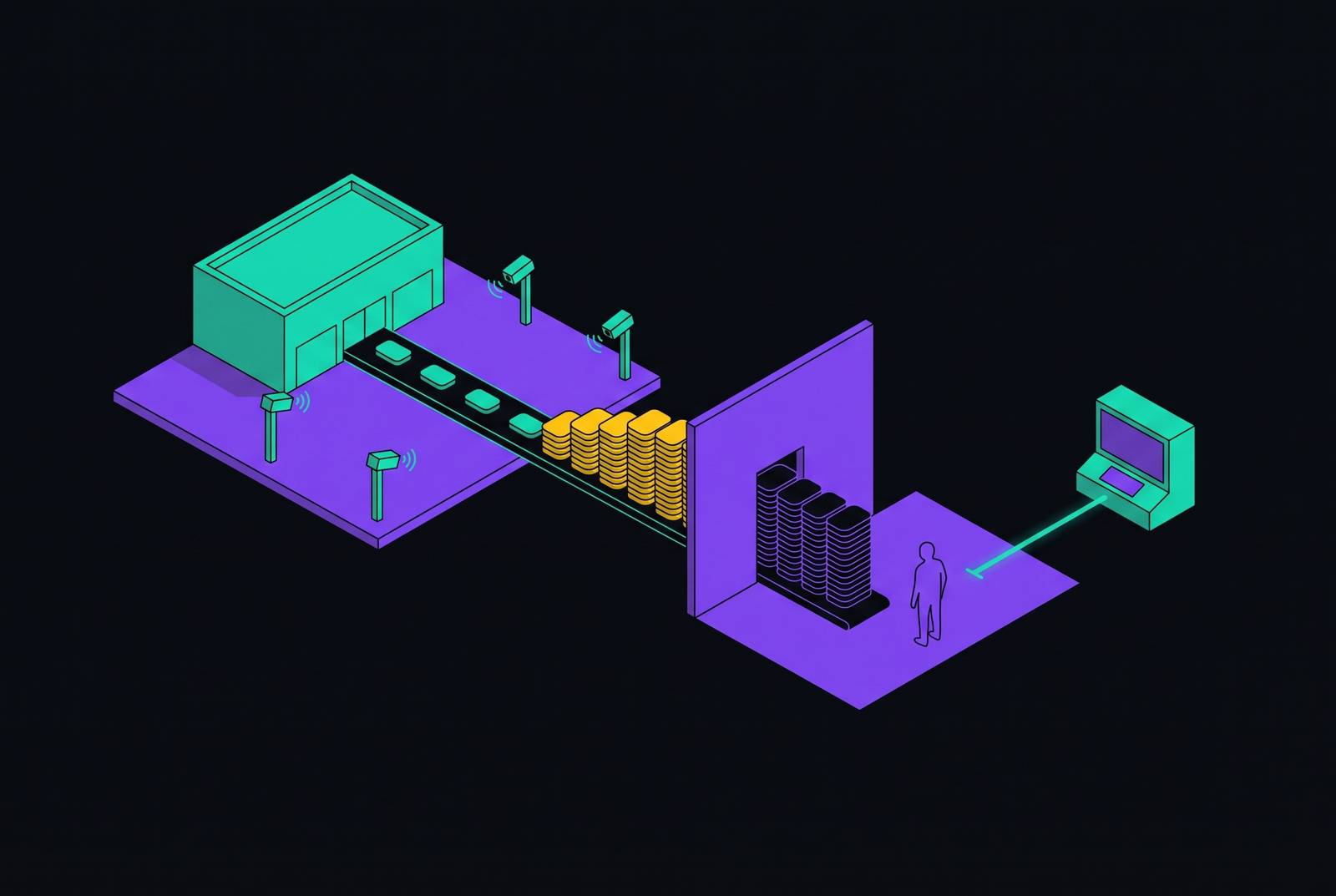
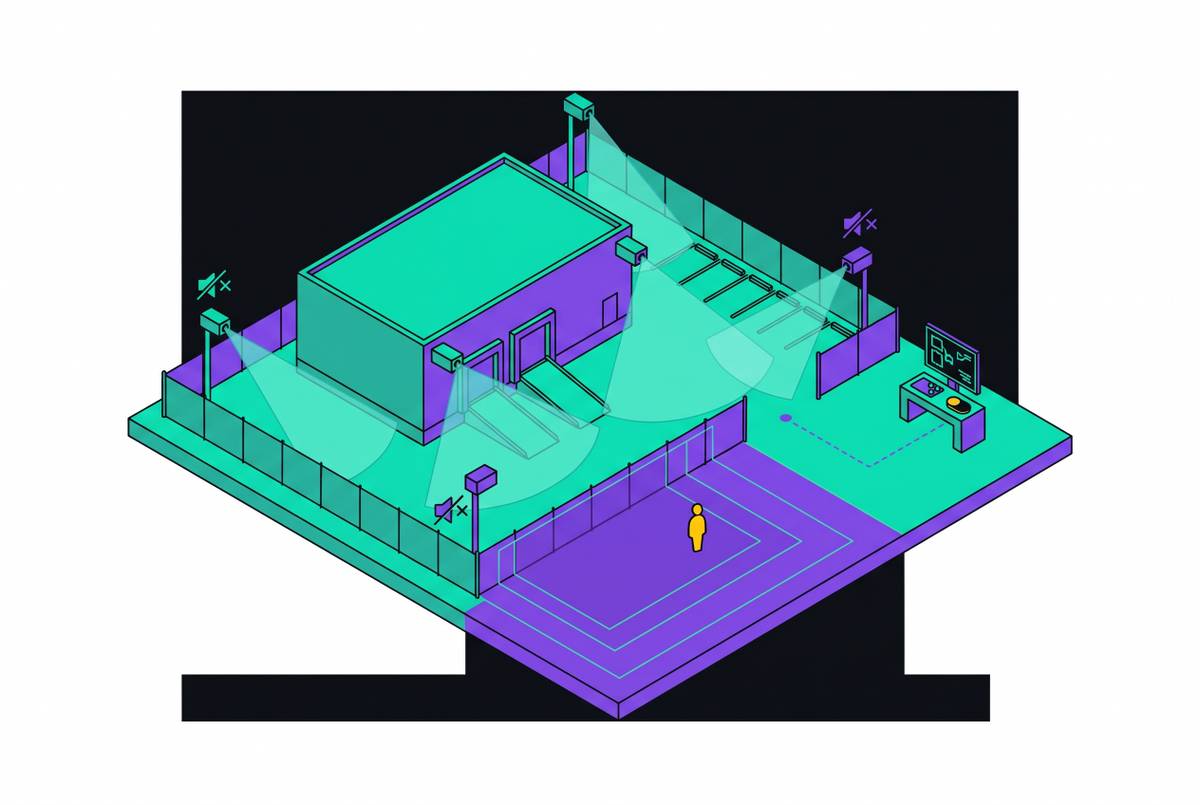
Alarm response time failure in traditional video monitoring centers occurs when incoming alarms outpace human triage and real threats wait behind routine noise. An alarm queue becomes a dead zone when cumulative delay exceeds the window for meaningful intervention. Queue depth, rather than operator count, is therefore the defining variable in monitoring architecture.
Why an alarm queue fails differently than other queues
Ordinary backlogs often make their failure visible through timeouts, errors, or warning dashboards. An alarm queue can instead lose an event without exposing the loss. The device may mark an alarm as reported even though the queue refused it, leaving the monitoring center with nothing to review and no apparent gap in the sequence. From outside the device, an alarm that never entered the delivery queue can look like an alarm condition that never occurred.
The simut alarm telemetry issue documents this mechanism. When a RAM queue fills while the server is unreachable, the edge latch marks a new alarm condition as “announced” even though it was never queued. The condition appears in the record only if it clears and re-trips, or after a reboot. This is not an ordinary staffing bottleneck. A threat beginning during that full-queue window is absent from the record until something resets the condition.
Why do traditional monitoring centers fall behind during high volume periods?
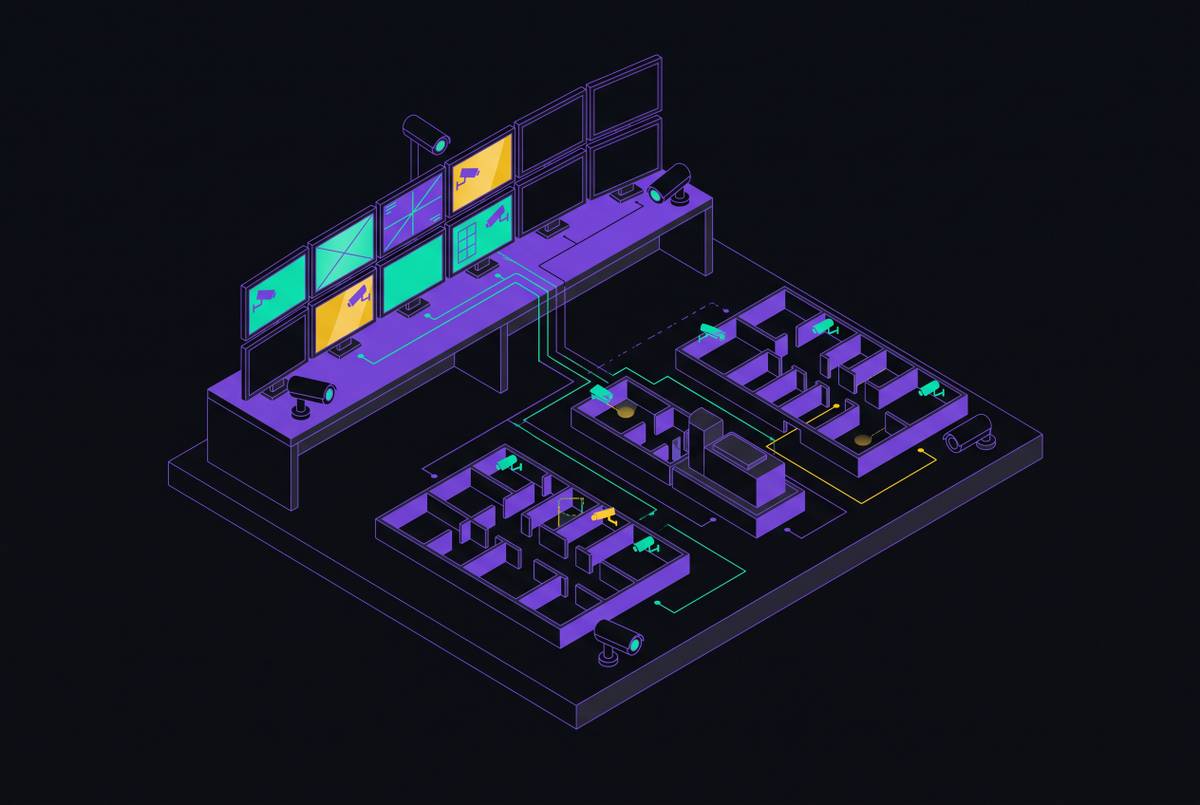
A traditional monitoring center reproduces the same failure logic at the human-response layer, although the alarm may remain in its records. Cameras send signals all the time, but the operators on hand can triage only so many alarms. Headcount cannot expand on demand as alarms arrive. When more alarms arrive than those operators can handle, real threats wait behind the routine events that already take up their time. The gap between signal generation and human review is the structural bottleneck.
Unlike the device-level failure, this backlog need not discard the alarm itself. Instead, it can silently discard the opportunity to respond. Operators keep working and dashboards keep running while a threat progresses beyond the point at which intervention could change the outcome. Continued activity is not evidence of effective coverage.
More operators can help a center get through more work, but the design still depends on human triage. The relevant distinction is therefore not between a busy center and an idle one, but between a queue that preserves time for intervention and one that consumes it.
What "queue depth" actually measures and why it predicts failure better than operator count
Queue depth measures the alarms waiting for review at a given moment. Operator count describes available processing capacity. A center with many operators and a deep peak-hour backlog can leave a threat waiting just as an understaffed center does.
Depth’s effect on response time depends on the work required to triage the waiting alarms and the capacity available to process them. Nevertheless, depth exposes the accumulated demand that headcount leaves out. It is the more direct variable for assessing whether a threat arriving now can reach an operator in time, rather than whether the center has substantial resources in general.
False alarms make that distinction especially important. The traditional detect-and-notify model generates alarms without the context needed to dismiss false positives quickly, so each event consumes triage time. A high false-alarm rate therefore adds depth while delaying the genuine threats mixed into the same stream. Noise becomes a response-time problem. An SLA based on uptime or operator count can show that a service is running without showing that the wait is growing.
The threshold where cumulative delay outpaces any meaningful response
The dead-zone threshold is the point at which cumulative delay leaves no useful intervention available. Below it, late attention remains a performance problem because a response can still interrupt, contain, or deter the threat. Above it, lateness becomes a coverage failure. The theft is complete, the person has left, or the damage is done. Monitoring may still support documentation, but that is a different function from changing the event as it unfolds.
There is no single threshold for every site. It depends on the threat category, the site, and what the available response could accomplish. Traditional SOC acknowledgment timelines measured in 30 to 60 minutes describe acknowledgment rather than necessarily establishing an opportunity for physical intervention. Acknowledgment alone is not a physical security response. The decisive interval runs from the alarm trigger to attention and action while action can still help.
Verified-response policies also set a limit on which alarms can lead to dispatch. Pittsburgh adopted tiered verified response in 2024, while Seattle adopted full non-response to unverified alarms in 2024. Milwaukee’s General Order 2025-50, issued in October 2025, updated a verified-alarm dispatch policy that had been in place since 2004. These policies make verification consequential to whether an alarm receives police dispatch at all.
A verified alarm can still arrive too late for useful intervention, while an unverified alarm can fail to qualify for dispatch regardless of the center’s acknowledgment speed. Together, these constraints show why a notification timestamp is an incomplete measure of protection. The response chain must produce both credible information and enough remaining time to use it.
How AI agents restructure the queue before depth accumulates
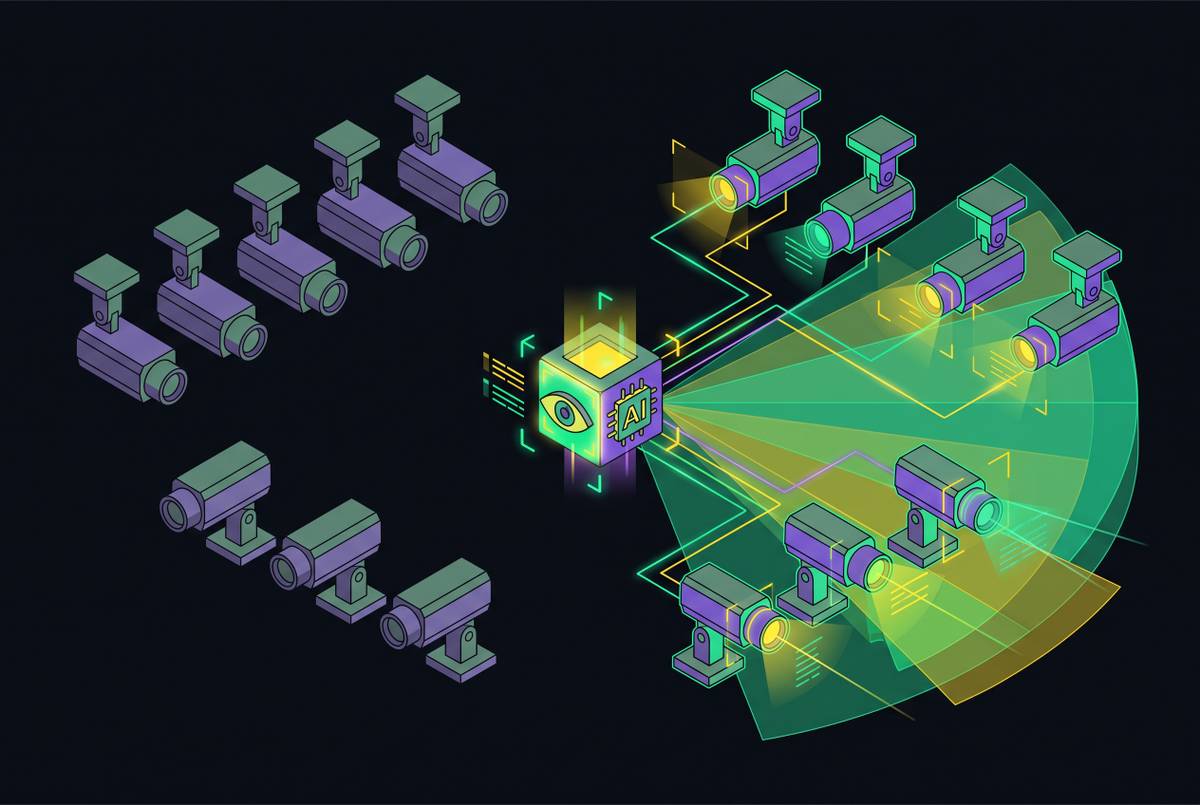
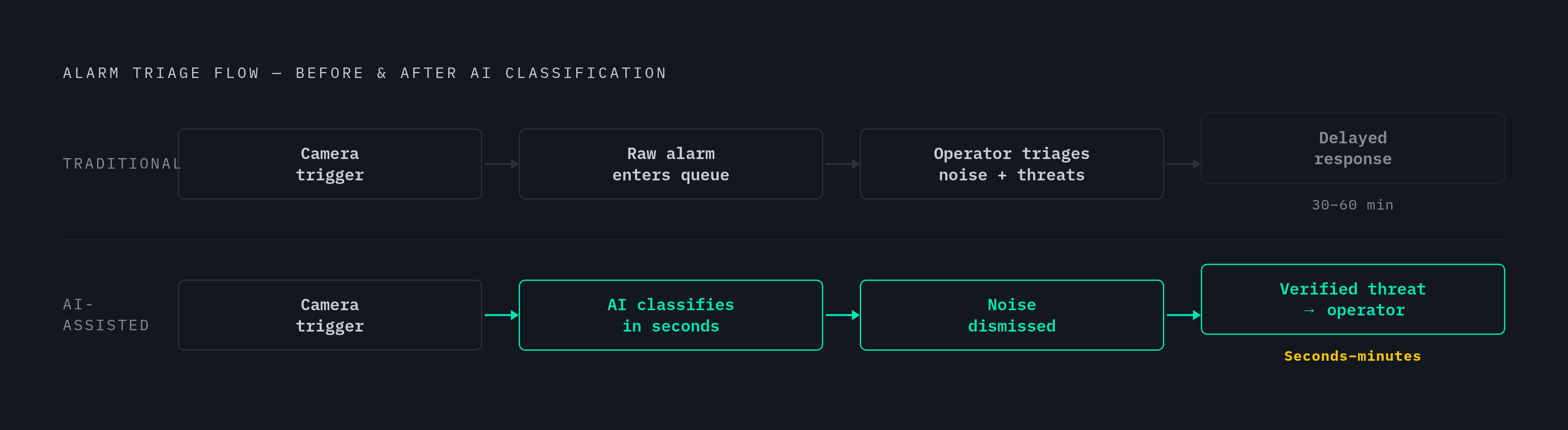
AI agents help close the throughput gap by classifying alarms before they enter the human review queue. This changes the input rather than merely accelerating the same manual workload. Environmental noise and authorized activity can be dismissed before operators spend time on them, leaving humans to respond to verified escalations. Mean time to triage can be compressed to seconds or minutes.
The emerging production design keeps the detector as the trigger and uses a vision-language model as a second opinion. Full model inference on every frame is too slow and too costly, so the agent reasons about flagged events instead. The detector identifies an event for review, while the agent evaluates whether that event warrants escalation. Human attention is reserved for the resulting verified threats.
This arrangement targets the source of depth. Rather than asking operators to clear a growing backlog of raw alarms, it removes the routine events that would create much of that backlog. A monitored queue of one would let an operator handle a verified threat without delay from unrelated noise. That result needs classification that gets the decisions right as well as fast computation. An agent that escalates the wrong events recreates the original burden.
Why site-specific context is what makes AI classification meaningful rather than just fast
A person near a fence line after hours can represent a verified threat at an industrial truck yard and routine authorized activity at a multifamily parking lot. Without site-specific context, an agent can replace sensor-generated false positives with AI-generated ones, so the human queue stays full for a different reason.
Schedules, access patterns, perimeter definitions, and known vehicle profiles show what authorized activity looks like at the site being monitored and give classification a site-specific reference. This context also helps when visual evidence is ambiguous. Unusual lighting, heavy precipitation, and dense foliage can degrade classification, while protocol information narrows the range of plausible interpretations.
If schedules or access patterns change without corresponding updates, the agent’s baseline no longer describes the site it is evaluating. Fast decisions against that baseline can send routine activity back into human review. For buyers, the useful question is not how many cameras the AI can handle. How does the vendor encode site-specific context, and how is it maintained when schedules and access patterns change?
What monitoring architecture looks like when queue depth is the design constraint
A design built around queue depth has AI classification at signal speed, site-specific protocol coverage, and human operators who focus on verified-threat response. Each layer addresses a different part of the bottleneck. Classification checks alarms before they enter the human queue, and protocol coverage gives it the context to tell noise and authorized activity apart from threats. Operators then act on verified escalations rather than repeatedly reconstructing that distinction from raw alarms. The layers depend on one another.
Protocol maintenance remains an ongoing operational responsibility. The classification layer cannot preserve its usefulness if the site’s rules change while its reference information stands still. Likewise, reserving operators for verified events requires classification to occur before human review. Placement is part of the design. A fast classifier downstream of the human bottleneck does not prevent that bottleneck from forming.
Communication-path resilience is a prerequisite to this arrangement. A single IP path without a supervised secondary can fail to deliver alarms during a CDN outage, no matter how many alarms come in. Dual-path device connectivity, using wired plus cellular service with store-and-forward buffering, is the minimum viable architecture described by this requirement. Classification can help only with events it receives. Delivery resilience addresses that upstream risk, while queue control addresses the delay after an event becomes available for review.
The corresponding SLA must expose queue depth. Buyers should require mean time from alarm trigger to human eyes on a verified event in place of aggregate mean acknowledgment time. Those measures describe different operational outcomes. The first measures the time from detection until a person sees a verified event, while the second can hide whether anyone saw it in time to act.
What buyers should actually ask before the next monitoring contract
For buyers, the practical test is what happens to a real threat when alarm volume peaks. The first question should establish mean time from alarm trigger to human eyes on a verified event. The next should address overflow explicitly. Do alarms wait, get muted, or get dropped, and what documented policy governs that behavior? An answer about total staffing does not resolve either question.
The evaluation should then establish who maintains site-specific context. Who updates schedules, access patterns, and authorized activity when they change, and how are those changes encoded? Delivery deserves the same specificity. Is there a supervised secondary communication path, and when was failover last tested? These questions connect the vendor’s classification claims to the operational responsibilities and delivery paths on which those claims depend.
Finally, buyers should ask whether the SLA exposes queue depth metrics or only uptime and operator count. Verified-response requirements in Seattle and Milwaukee, and Pittsburgh’s tiered policy, make this more than an internal performance discussion. An unverified alarm that arrives after the useful response window may receive no police dispatch at all. The decisive evidence is whether a credible threat can reach a person with enough time left to act.