The Accountability Gap Muted Cameras Leave in Incident Reconstruction
Muting noisy cameras cuts alarms but can erase evidence.
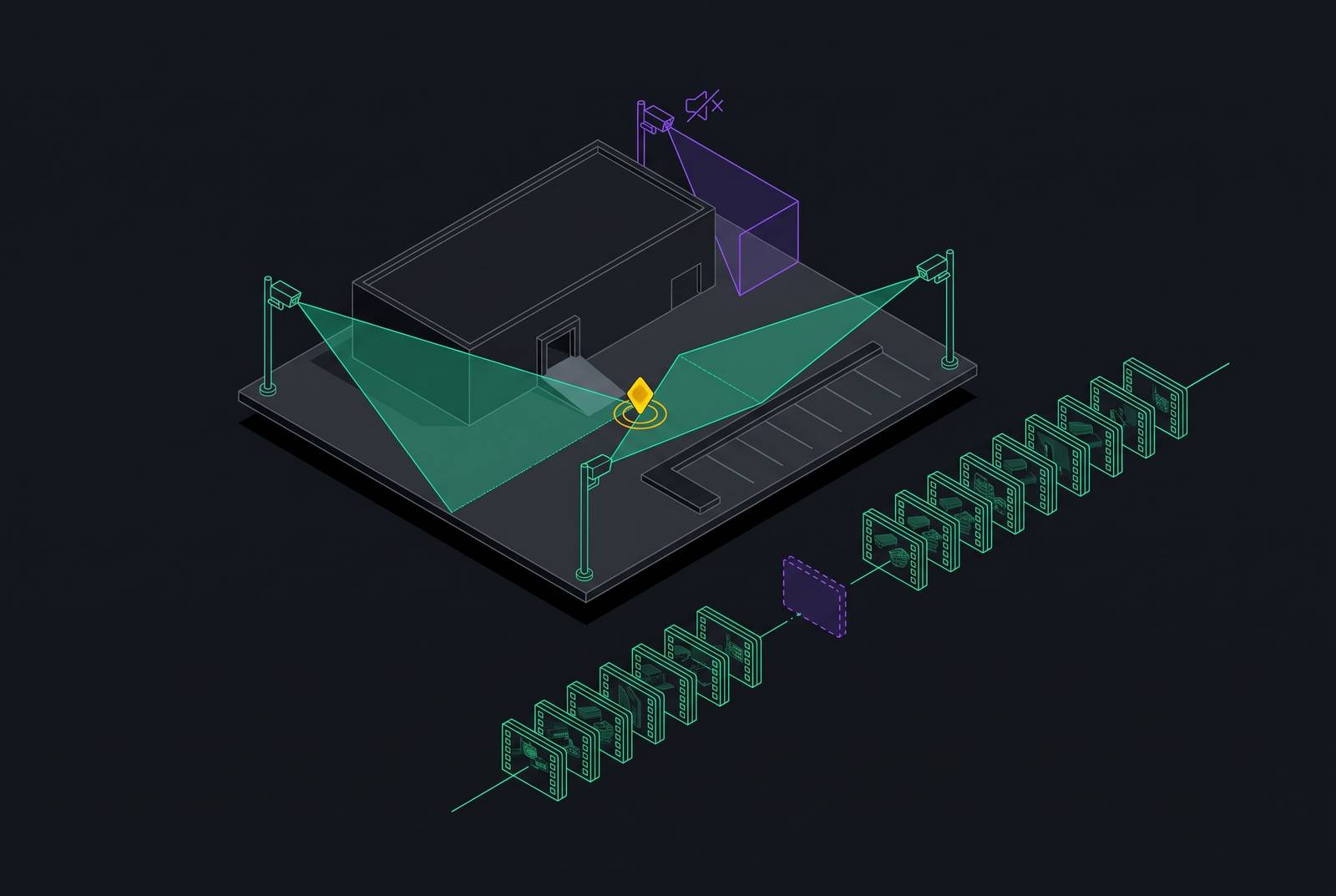
Muting noisy cameras reduces alarm volume by removing events from review. When that shortcut also suppresses recording, it permanently removes footage needed for incident reconstruction, insurance claims, and legal proceedings. The accountability gap closes only when monitoring can resolve alarm volume while preserving coverage and a usable record of what happened.
Why incident reconstruction depends on footage that operators assume exists
An investigator, adjuster, or attorney asks for footage after an incident. At that moment, the organization must produce more than proof that cameras were installed and running. It needs a record that shows what happened, where it happened, and in what order. A functioning camera does not establish that footage is available, reliable, or usable.
Security teams may need footage right away, while HR, legal departments, and insurers may ask for it days or weeks later. Those later reviewers were not necessarily involved in the original response, so the record must support an account they can reconstruct independently. Their questions outlast the live monitoring shift. Footage that was overwritten, or a camera that was installed but never checked, cannot provide the missing account.
The Office of Justice Programs review of 40 years of CCTV research found that actively monitored schemes generated larger crime-reduction effects than passive systems. That finding concerns prevention. How a system is managed changes what it delivers. For reconstruction, management must keep documentation that people can use as well as keep cameras running.
Why do operators mute noisy cameras to reduce false alarms?
Legacy detection systems can overwhelm operators with alerts caused by shadows, headlights, and pigeons. When sensitivity is too high, ordinary activity repeatedly enters the same queue as a potential threat. Someone must check each alert before they know whether it matters. The queue becomes the immediate operational problem. Under that pressure, reducing notifications can appear more urgent than preserving the review of every camera.
Muting is a rational response to an unmanageable workload. Alert fatigue sets in when repeated noise teaches people that the next notification probably will not need action. A real threat can then wait behind alerts that offer little useful information. Raising thresholds or silencing a noisy camera reduces that burden, but it also changes which events receive attention. False positives are exchanged for the risk of false negatives.
Muting cuts coverage to shorten the queue, while overage fees make it cost more to handle the same flow. Staffing cheaper offshore seats changes the labor arrangement without correcting alert quality. Each approach leaves the underlying detection problem in place. More cameras can intensify it by adding alerts to a workflow already struggling to distinguish significant events from noise.
Camera count is not a safety metric. A larger deployment can provide more views while producing a less manageable workload for the people responsible for acting on them. That is the link between the live queue and the later documentation failure. A decision made to keep the current shift workable can leave the organization without a defensible account when an incident is reviewed.
What muting actually removes from the evidentiary record
The consequence depends on what the system silences. Muting notifications removes events from the live review and response workflow. Where muting also prevents recording, every event that would have been captured during that window is permanently absent. Missing a review and losing footage leave different but linked gaps in the account of what happened and who was responsible.
The missing detail is often concrete enough to decide an investigation. Reviewers need a usable view to identify a face, confirm who entered a restricted area, read a license plate, verify vehicle movements, or establish whether a tool, asset, or inventory item was taken or moved. The missing interval may contain the decisive action. Footage from before or after it does not necessarily answer the question.
Sequence is equally important in a slip-and-fall, safety incident, or customer dispute. A record must show enough of the event to establish what preceded it and whether safety procedures were followed. Missing or unreliable footage weakens that account and can weaken an insurance claim. Poor documentation can mean longer investigations, more staff reviewing footage, more second-guessing, and weaker positions in disputes that clear footage could have resolved.
The operational consequences vary by property, but follow the same failure. In multifamily properties, a recording gap can become a tenant safety issue. On construction sites, it complicates incident reporting and subcontractor accountability, while in warehouses it can leave inventory shrinkage unexplained. These problems persist after notifications resume and emerge when another party asks the organization to substantiate its account of an event.
Why regulated and multi-site operations carry a compounded version of this risk
Regulated operations have a duty to keep a record they can trust, and missing footage is part of that duty. Tamper-proof audit trails and automated retention enforcement are part of that obligation. When legacy systems supply raw footage without metadata integrity, access logs, or automated archival, staff must do the work to fill those gaps by hand. The burden extends beyond finding a recording. The organization must also account for how the record was retained and handled.
Without clear access controls and audit trails, a business can struggle to establish who viewed, downloaded, or shared recordings. That uncertainty adds a governance problem to the original incident. Manual processes may consume substantial time while remaining difficult to defend in a compliance review. The footage alone cannot answer every audit question. Its handling history must also be available when the record is examined.
Multi-site operations face more difficulty when their sites use different systems. An incident touching cameras at two sites may require reviewers to piece together records that were never presented as one account. Siloed alert queues create a related response gap when face recognition flags one dashboard while an ANPR system flags another. Someone must perform the correlation manually.
The consequences also reach beyond internal review. Police departments increasingly need verified alarms before they dispatch officers, so unverified notifications may lead to fines and slower response, delaying help that could stop the threat. Meanwhile, false negatives from muted or over-thresholded cameras can become compliance gaps, audit findings, and fines. Both failures start with gaps in the account of what happened. At scale, the requirement is not merely to retain more footage, but to make verification, retention, and oversight enforceable across the operation.
What a usable incident record actually requires from monitoring architecture
A monitoring architecture must keep three things intact together: alert precision, audit-trail integrity, and response documentation. More storage does not establish who accessed a recording, and another camera does not explain what action followed an alert. Those are functions of the monitoring workflow. The specification must connect detection to a record that another reviewer can understand.
That record requires clean timestamps, camera IDs, and location tags, together with a log of what the system did and when. These details anchor footage to a place and sequence rather than leaving investigators to infer the connection. An intrusion alert with an attached clip, location tag, and timestamp provides that context without requiring someone to watch continuously. Speed also affects what can be documented contemporaneously. Delayed delivery can close the window for intervention before an operator begins verification.
At every event, video alarm verification must establish what is visibly happening, what remains unknown, which action is authorized, and who owns the next step. The workflow must leave enough documentation for another reviewer to reconstruct those decisions. Darkness, glare, obstruction, or weather that makes a view unusable must appear as an exception.
Offline cameras, unavailable feeds, and storage nearing capacity need to become visible exceptions. Automatic access logging must record activity without depending on an operator confirmation step, because manual logging can leave gaps that are difficult to defend. Retention enforcement must likewise support later review. Together, these properties preserve both the footage and the history needed to explain its limits, handling, and use.
Why AI-native triage is the only architecture that closes the queue without muting coverage
The defining difference in AI-native triage is where verification occurs. AI agents check alarms before they reach the human queue, so a human does not have to clear every detection. This separates the volume of detections from the volume of work requiring human judgment. Cameras do not need to be silenced to achieve that separation. The architecture addresses the cause of muting rather than treating reduced coverage as an acceptable way to manage workload.
Human remote guarding scales with headcount because it substitutes remote labor for on-site labor. It needs more capacity or workarounds to handle alarms at their peak. AI-triggered monitoring changes that relationship by filtering feeds and surfacing probable events for human review, while agentic AI adds continuous reasoning about visible activity and documentation. The operator resolves surfaced exceptions. Ambiguous or high-stakes events still require human attention.
The division of work is specific. AI handles high-volume pattern recognition, noise filtering, and context assembly, while trained operators handle threat verification, communication with on-site personnel, and decisions requiring nuance. Every alarm must be reviewed within a set time. Every resolved event must also leave a documented record, whether or not it escalates to a human.
That rule keeps AI from hiding events without a trace. A model that keeps getting things wrong can bring back alert fatigue by flagging noise as a threat over and over, teaching operators to pay less attention to its alerts. AI is not a substitute for demonstrated performance. Buyers should insist on before-and-after tuning data from their own footage. The model must cut reviews that humans do not need to do while keeping events that matter, cases that are unclear, and the records of both.
The system must preserve coverage while documenting what was assessed, what remained uncertain, and what happened next. That is the standard against which reduced alarm volume must be judged. Muting makes the workload smaller by withdrawing attention, while effective triage makes it manageable by completing the assessment that attention was supposed to provide.
Sources
- When Cameras Catch the Incident…and AI Clarifies It: How Modern Video is Changing Injury Cases - Kane Personal Injury
- How to Document Security Incidents Correctly - A Security Training Academy, Inc
- Security Incident Documentation That Stands Up - Maritect Investigations & Security Limited
- SWGDE Recommendations and Guidelines for Using Video Security Systems - SWGDE
- AI in Physical Security: What Is Actually Changing - Security Industry Association