The Backlog Clock How Unreviewed Alarms Age Out Before Any Operator Reaches Them
Threat verification before human review prevents real intrusions from aging out in alarm backlogs.
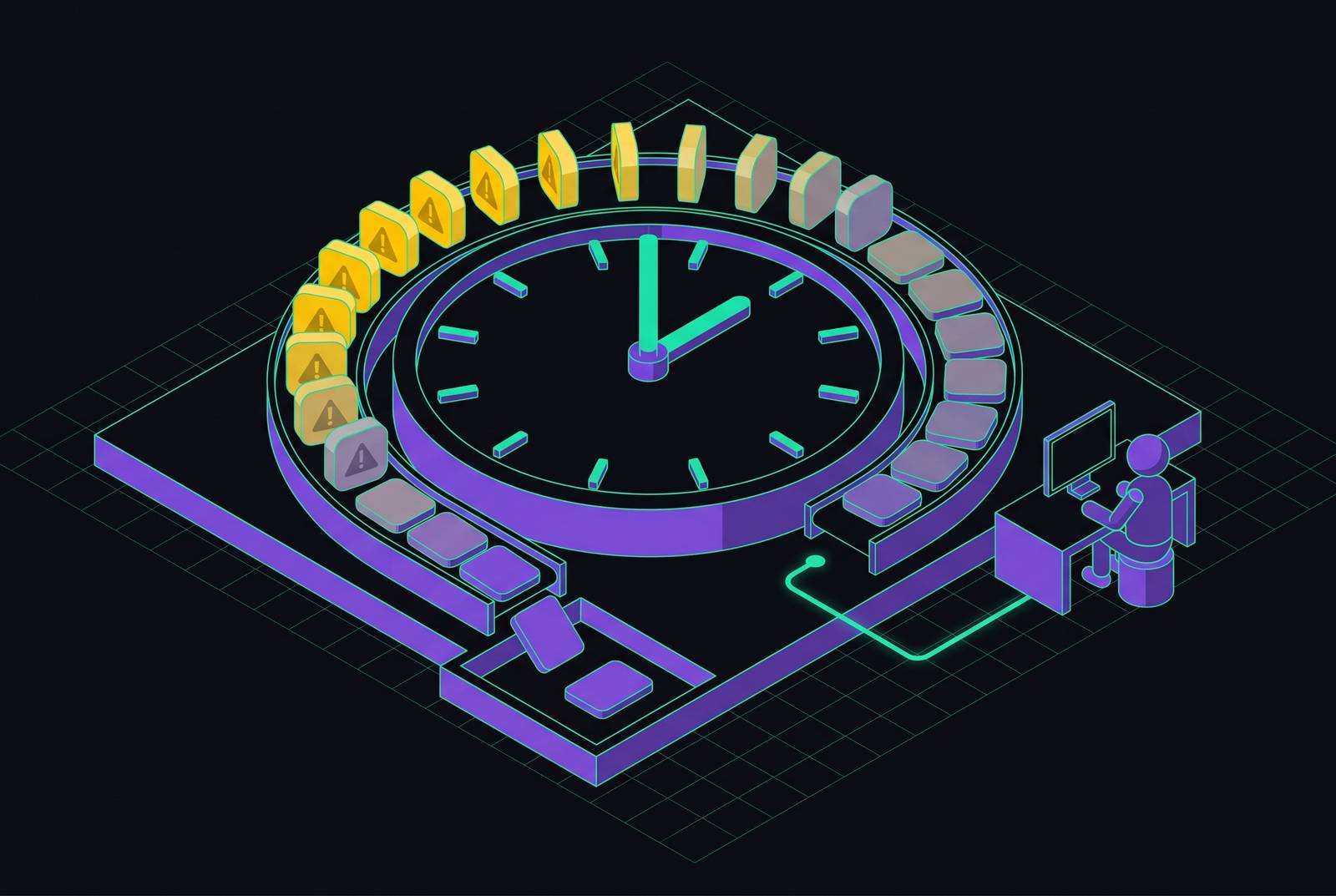
Alarm response time in traditional video monitoring centers starts to fail when alarms get reviewed in arrival order, whatever their urgency. It can be too late to stop a real threat by the time operators finish checking the harmless events ahead of it. The backlog clock is an architectural problem, and resolving it requires threat verification before human review.
Why the queue model, not staffing levels, determines when a real threat gets seen
An operator sitting at a console at 2 a.m. has no structural way to know whether alarm 47 is a raccoon or a burglary in progress. The queue does not tell them the difference. Motion triggers, environmental noise, authorized activity, and genuine intrusions arrive with the same weight, leaving the operator to establish their significance manually. Until that review happens, a threat has a place in line but no priority based on its urgency.
That arrangement makes triage a prerequisite for every decision. Before an operator can dismiss an event or respond to it, someone must spend time determining what happened. Each harmless alarm therefore consumes review capacity that a genuine intrusion also needs. Under volume, those individual demands accumulate into a delay that has little connection to the seriousness of the next unseen event.
Additional operators can share that work, but they cannot make the queue reveal what it contains. A threat waits behind earlier arrivals because the system has not yet distinguished it from them.
Why do security monitoring centers fall behind on alerts during high-volume periods?
False positives make undifferentiated queues persistently expensive to process. Environmental triggers, motion artifacts, and authorized activity account for the overwhelming majority of alarms in legacy monitoring centers, so operators spend most of their working time clearing noise. When nearly every alarm needs to be checked but calls for no protective action, even normal traffic keeps the backlog clock running.
Volume also changes the quality of the review. Repetitive processing of low-signal events degrades attention, leaving increasingly fatigued operators to recognize the genuine threat embedded in the same stream. At the same time, high false-alarm rates lead centers to add manual verification before dispatch to avoid costly mistakes. Those checks serve a legitimate purpose, but they slow the processing of real alarms as well as false ones.
Noise consumes review time, extra verification reduces throughput, and meaningful events spend longer waiting for attention. A surge intensifies a weakness already present in the normal workflow.
MITRE ATT&CK documents a closely related adversarial behavior under T1562.011, named “Impair Defenses: Spoof Security Alerting.” Adversaries generate false alerts to overwhelm defenders and bury meaningful signals. This makes the backlog more than an inconvenience. A defense that allocates attention to arrival order can have that attention consumed deliberately.
What happens to an alarm as it ages — the mechanical delays inside a monitoring center’s workflow
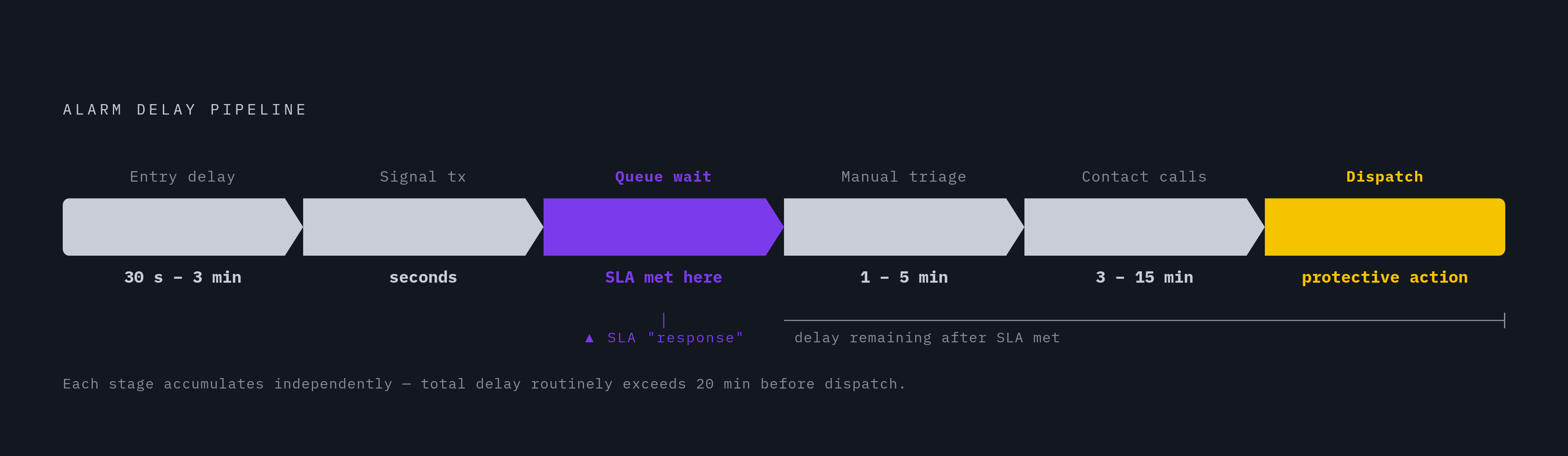
An alarm begins accumulating delay before an operator can review it. Most alarm systems include a programmed entry delay of tens of seconds to several minutes so that authorized users can disarm the system. The triggering event and signal transmission are therefore not necessarily simultaneous. That allowance is reasonable for legitimate access, but it also uses part of the intervention window when the event is a genuine intrusion.
After transmission, the signal enters the monitoring workflow and waits for attention. The standard contact procedure then involves calling the property contact, followed by a second and a third contact before notifying authorities. Those calls are intended to reduce false dispatches. Nevertheless, they add minutes to the event, on top of the entry delay and the time already spent in the queue.
Peak volume stretches the chain further as call queues grow and operators handle a high volume of signals. No single step has to be unusually slow. The failure can emerge from several individually reasonable delays occurring in sequence while the event at the property continues.
The reported service metric may cover only a small part of that interval. Monitoring SLAs typically measure response time as time-to-acknowledgment of an alarm or request, rather than time-to-verified-response or time-to-dispatch. A prompt acknowledgment can therefore coexist with delayed protective action. What the center reports as a response and what the property experiences as one are different intervals.
What the gap between queue position and urgency costs when a real threat is in the backlog
The opportunity to catch an intruder on site, preserve evidence, or enable police to arrive during an active event narrows as minutes pass. Queue time is time available for the threat to complete its objective before anyone has established that intervention is necessary.
This is why speed to a verified threat is more useful than alarm volume as a measure of protection. Human operators scanning feeds take substantially longer to detect an incident than AI-powered systems that flag the same event in a fraction of the time. That difference affects when response can begin. Recording more events does not compensate for recognizing the consequential one after the useful response window has closed.
Verification also affects what happens after monitoring-center review. Many jurisdictions fine businesses for repeated false alarms, while an increasing number of law enforcement agencies use verified-response policies that deprioritize unverified calls. A slow, unverified escalation can therefore encounter another delay beyond the center. False alarm response costs and the absence of documented, verified monitoring also affect premium exposure for commercial and multifamily properties.
Installed cameras and a monitoring agreement can suggest coverage without revealing how long alarms remain unreviewed. The gap becomes apparent only when an incident is recorded but receives no timely response.
Why adding operators or muting cameras treats symptoms while the queue problem continues
Adding operators is a reasonable response to an immediate workload problem. It increases available review capacity, but cost scales linearly while incoming alarm volume continues to determine the work entering the queue. During a surge, even a center with a full staff has to put every event through manual triage. The limitation lies in the workflow.
Muting noisy cameras reduces that workload by removing signals. It also removes coverage from the affected cameras. A muted camera is not a filtered camera, because filtering distinguishes useful events from noise while muting leaves the camera unmonitored.
Offshoring changes the labor cost without changing this sequence. An offshore operator still has to establish what each undifferentiated alarm means, often with higher turnover and less site-specific context.
Overage pricing exposes the same dependency in financial terms. When alarm volume exceeds what the staffing model anticipated, the center charges more. The buyer can face a higher bill without a corresponding improvement in response time. These measures manage labor, volume, or cost, but leave humans responsible for sorting the full stream before threats can receive priority.
What a different architecture looks like — AI agents reviewing alarms before any human sees them
AI agents review every alarm first and escalate only verified threats, removing routine triage from the operator’s workload. This is a change in the order of operations.
Context makes that distinction possible. An agent can distinguish a person climbing a perimeter fence from a branch moving in the wind by drawing on site-specific baselines, camera placement, time of day, and access schedules. A vision-language model can describe the event as “a person is climbing the perimeter fence at the north gate”. That sentence gives the operator an actionable account without requiring an initial footage review simply to identify the event.
The Monitoring Association’s ANSI/TMA-AVS-01-2024, the Alarm Validation Scoring Standard, formalizes a related shift toward evidence-based classification. Its five-tier framework, Level 0 through Level 4, replaces a binary intrusion/no-intrusion signal with classifications based on the evidence on hand at dispatch. AI reasoning can change which tier an alarm reaches before a human confirms it. The relevant advance is the evidence supplied.
That evidence depends on how the property is used. A dealership perimeter, logistics yard, multifamily lobby, and manufacturing restricted zone have different authorized activities and operator runbooks. Without those baselines, an agent can produce false positives just as a motion detector does. With them, the operator’s work shifts from sorting noise to exercising judgment and responding to verified threats.
How the architecture performs differently across commercial, multifamily, and industrial sites
Alarm composition varies by site, but simultaneous activity can still converge on the same human review capacity. Site-by-site AI screening separates that activity before it reaches an operator. Protocols must apply each location’s context to its activity. People can then focus on verified threats without waiting for unrelated alarms ahead of them in the queue to be reviewed.
At multifamily properties, the baseline for authorized access is more complex. Residents, guests, delivery personnel, and maintenance workers generate legitimate motion at all hours, making motion alerts of little use without property-specific context. Static guard posts are also a substantial expense. At a large Class A property, full-time guards, monitoring, equipment, and false alarm response fees can represent a meaningful share of operating costs. AI-augmented monitoring allows guard coverage to shift toward verified-response dispatch, recovering cost while improving threat detection.
Industrial and construction sites put more weight on watching remote perimeters. Construction theft and copper theft create project-budget exposure, while the absence of after-hours personnel can leave the monitoring center as the only protective layer. AI camera monitoring per site per month costs a fraction of a static overnight guard post and can cover events beyond what one guard can physically observe. Distance adds a distinct detection challenge. High-resolution image slicing divides frames into smaller segments for parallel AI processing, supporting early detection across logistics yards, construction zones, and campus perimeters.
What buyers should actually require from a monitoring SLA — and how to tell if the architecture behind it can deliver
For a buyer evaluating these claims, the starting point should be the response-time distribution. Ask to see the gap between the fastest and slowest responses, because an average can hide the events left waiting when alarms pour in. Variability exposes the backlog that a single number conceals. The service commitment should address the time from alarm trigger to a verified threat reaching a human operator, rather than ticket assignment or acknowledgment alone.
To evaluate whether the architecture can support that commitment, ask how the provider sequences alarms. Find out whether the most urgent alarms get reviewed first or people still review them in arrival order. Then ask what happens during peak volume and how much response time stretches. Those answers reveal whether the provider has changed the review process or merely staffed the same queue more heavily.
An AI claim requires equally specific scrutiny. Ask whether a human first sees the alarm before or after AI pre-screening. Ask what site-specific context the agent uses to distinguish authorized activity from a threat at your property. The distinction must be operational. An AI layer that leaves people reviewing the same undifferentiated stream has not removed the triage bottleneck described here.
Finally, require the response commitment to reflect active, continuous monitoring. Camera count describes equipment. The decisive measure is how quickly a verified threat reaches someone able to act, including when the alarm stream is at its busiest.